i’m ashamed to write another diasporic poem
about cut fruit, but it’s true
i didn’t realize how much my mother loved me
until i cut into a pomegranate for the first time.
shiny red jewels bursting like boba,
my cutting board a battlefield,
shirt a virgin’s underwear,
splotch of red, sea of white
like the flag of a home i’ve been to just once
and the sour tang of your favorite,
yuriko-chan, umeboshi gohan.
i wonder how else my mother stained her fingers
to nourish me.
fruit aside,
i can recite all manner of asian american clichés—
my lips fit awkwardly around my mother tongue,
but at the counter of the japanese grocery
the cashier says hello, how are you?
the atrophied muscle is vestigial.
there is no way to say i’m proud of you
in japanese, which means my mother
selflessly learned the words in english
without the insurance of reciprocity.
i mentioned i was japanese at work
and all my co-workers could talk about
was the allure of an oriental honeymoon.
they’ve vacationed in my motherland
more than i’ve returned.
maybe i’m yellow on the outside
and white on the inside,
but i can’t be sure unless you
peel the banana, let my innards spill out
overripe like an apple too far from the tree
and tell me what color you see.
when cliché falls short, turn to fact—
there’s open gashes on foreign soil
still raw, still filling imperial reservoirs
slaking the thirst of bureaucrats
who preach the lie of post-
there’s camo-clad parasites
breeding a new race,
twice-stolen lands sharpened
into something that kills.
there’s little yellow-white girls
who look like girls, but sexier,
little yellow-white people
made in someone else’s image.
there’s a little boy who feared white devils
and a daughter who married one.
what’s more cliché than a yellow-white child?
Juliana George is the managing editor of Illume Magazine.
**
“Her young demise was just an accident in the fire.”
I looked at the candle from the bed and I knew that
I would want to let it burn. Let it burn until I found
the place to carry on my true life.
Oh, how wonderfully orchestrated.
Take me there, and I would finally be fine.

Every being was born under blessing.
Everlasting fates were beginning.
That was a place where every time
I thought about reunions with the precious, a cat
reaching its maturity stopped at my heart, quietly resting.

In that life my greatest fault was nothing more
than keeping the reading lamp lit at night.
People were fearless, yet no true malice ever existed.
Apologizing was not for forgiveness but for taking responsibility.
And honesty was by any means recognized.

There would be a day when my gut digested slower
than ice cream melting in the snowy season.
Walking to the grocery store at the end of the street
took longer than the sun climbing down the mountain.
Remembering my name was harder than bending my knees.
And I could, with people holding my hand, give my heartbeat
to another lively person.

Then in my afterlife, I was my parents’ parents.
I said: “Listen, growing up is a long distance.”
But they understood how they could always be
forgiven and restart as long as they took the step.
And they never ceased to look around and find
some dependence.

**
But I suffocated the candle, as I should.
I wish I could just let it burn.

Let it burn until I forget that the small ambitions
drifting to the sky fall as a rain of enmity.
That hugging me is like grasping the dissolving
grain of salt in the sea. That even though I start
conforming to what is real about me — crying and explaining,
No one believes my tremendous fear of humanity.

Let it burn until I forget that the sun of another day
is rising when the brain of yesterday is still simmering.
That I find no remedy for longing but sinking in a hallucinated memory.
That I have not touched another person for a long, long time.
That my commodified heart can no longer say a word of true blessing.

Let it burn until the lyrics breeze to my chest when
there are a thousand lost souls singing the song of solitude afar.
Until I am at a loss of judgment if I am leaving the world
or the world is leaving my heart. Until I am ready to disappear.
And until the wind agrees not to snuff the light of another
candle — because that one belongs to my mom.

**
Next time I would let it burn, would I?
Let it burn until “Her young demise was just an accident in the fire.”
When I flee all I feel will be my mother saying the spring is coming.
Oh, how wonderfully orchestrated.
Take me there, and I would finally be fine.
i turned twenty one and donned girlhood.

the following hangs inside the closet of my society’s making:

seven saris, nine pairs of teetering heels, every single person

i couldn’t bear to keep but somehow cannot forget. my body,

soft and protruding in all the right places—collarbones, chest,

the points of my hips scraping like knives to my flesh,

weaponry to keep the people away.


when i find the right one, i will let them in and

smother the urge to turn the sharp edges on myself.

so here i am with no fight nor turning back.

light limns the frame. i turn away from the door

but cannot ignore the spaces: outside air stubborn.

then waiting. rushing in.
Noor Mehta is an international affairs and anthropology major at Northeastern University.
not a song, not a statement, not a country, not a man
radio I ought to bury you in my chest.
The taxi-driver says they found a hand by the park and he’s sorry most of all
and the newsmen all look (because they are) like good industrialists, split from the first
fruit with a force like the spit the workers send flying to the pavement. the woman with the knife
in her palm at the table not even noticing he is dead. grandfather like nation I would like to forget you. in the sky the stars on earth the spines
in my heart?
to music [the administrant says] a huayno as white as the white city
my father says (the way the politicians say) that he died by coincidence
in all the dress of a poem. machine, filth, and contradiction. crumbling
like hospital, I ought to slip a palm right through you
I, can hardly see myself between the lines of two torsos
in the street as definite as the mountains that flank them. an old man with lungs long since failed. helmet, boots, youthful stance. far from each other. singular point. kisses pouring from intersection. my mother’s eyes as singular point. and one body
whose bruises shine white like street lamps making maps in receding distance.
not a song, not a statement, not a country, not a man, in the sky, on earth, in my heart, I would like to die, to forget you,
I told my motherland, I can read you a little now, and I wasn’t talking about language.

I told my motherland, I will never be there, and I wasn’t talking about boarding the plane.

I told my motherland, I can only see diaspora, and I wasn’t talking about disconnect,

though even just the word reminds some of us invisible. I wish to be coddled tonight—

though I need you to know I wasn’t talking about dating preferences either,

though they do always run imposterous; there’s this thermal misunderstanding

of what the hands direct the body to desire, within or without, my body or

your body, my house or your house, a family of expectations couldn’t really help,

much less say. I don’t ever really listen— maybe I was talking about the milieu

I realized myself in, which now I realize myself in. The sound of my socialization

succeeded me for some time: I was met by English and only in English can I speak myself

into existence as a burgeoning thing. I was met by those who have never felt belonging for the soil,

felt the ache of being seed to wind like I am still searching for a place to be buried not upon death

but upon growing tall again. Motherland, I mean it when I say this life feels half-hearted and

I won’t even begin with the parts of my identity that almost feel let in like a dream,

like my name, fictitious as the shelter I grew up in. Assimilation a continuation of

leaving behind home. I must have begun already, but Motherland it is how we must

remind ourselves (not just others) to cling to the specifics of our ethnic credibility,

introduce ourselves succinct in a field of whiteness— swallowsome as it is, our muted bodies colliding

into each other like seawater. sometimes only approximations of the light. light like whiteness, whiteness

like light: sometimes I am blinded, sometimes I am assuaged. It will never save me; a buoy is painted red to

a sea. It will never save me; as long as I am soldered to this speculation, I will be coming up for air,

we are still tainted, not just by how far we are from light, but how close we are too. It will never save me,

as long as we are still searching for vantage points of appropriation and upturning the empire’s hand.

The empire has shown its hand so many times before playing and yet here we are still polluted;

non sequitur in each other’s skies. The other week, someone in bed told me they almost wished

I were a women— and I didn’t even feel grave, only I have been here before. This lobby is a cramped

space and I feel like I have been here too long, sometimes it feels all too wishful. But I'll say, Motherland,

I think I finally have what it takes to leave. I don’t mean America, or even family where you are.

I love us counterparts; I was talking about letting go of false memories, never known joys.

For Motherland, I know this is difficult to hear, but I will never be your child and

I will never be your lover, yet I will likely never forget the feeling of being the space in

between homes. I will still catch light. I will still speak sound into the body.

we will all still catch light, for we are secessions of the land just as much as it seceded us.

making something of a home out of what passes through the window.
Kevin Zhang is the literary arts editor of Illume Magazine.
In this year’s U.S. presidential election, there was no option to vote against genocide and settler colonialism, to vote against fascism, to vote against the accelerating deterioration of the planet.
By Juliana George
DEC 21, 2024
More frightening is the knowledge that there was no option to vote against genocide and settler colonialism. Illustration by Karissa Korman.
Every day, there is more horror: Palestinians desperately awaiting aid trucks meet fiery deaths by Israeli airstrikes; children’s malnourished bodies are buried under rubble; school shelters housing dozens of families are targeted and destroyed. The images are nauseating, incomprehensible, accusatory; they implicate us all in their monstrosity. If you look for it, the carnage never ends.
These abominations are not happening because Donald Trump was named the next president of the United States Nov. 6. They have been ongoing for over a year, endorsed wholeheartedly by President Joe Biden and Vice President Kamala Harris. Even after unambiguously losing both the electoral vote and the popular vote, the first Democratic campaign to do so in 20 years, this administration is unshakeable in their commitment to perpetrating a genocide. Even with nothing at all to lose, and after explicitly warning the Israeli government to cease impediments to humanitarian aid within 30 days or risk an arms embargo over a month ago, the Biden administration will not stop arming Israel.
Harris’ brief 107-day campaign felt like a parody of itself, a case study in shallow identity politics and neoliberal hypocrisy. The campaign inexplicably moved further right than Biden’s, with the vice president vowing to appoint a Republican to her cabinet, pledging to up border security and raise the bar for asylum claims, steadfastly backing domestic oil drilling, and making practically no mention of the working class. All the while, the internet flooded with Kamala “Brat” edits, mania surrounding Maya Rudolph’s SNL impression, and meaningless celebrity endorsements ranging from Taylor Swift to Dick Cheney.
Rather than changing course on a ceasefire deal or arms embargo that would have likely won her a larger share of the youth vote and Arab American vote, Harris opted to cut off pro-Palestinian protestors at a Michigan rally with her much-memeified signature girlboss quote “I’m speaking.” When asked whether she was concerned about her standing with Arab American voters because of her administration’s support for Israel, she said that despite the “many tragic stories coming from Gaza… the first and most tragic story is October 7.” She later lost Michigan to Trump during the election, particularly underperforming in cities with large Arab and Muslim American populations that had previously gone blue.
Rather than countering Trump’s extreme stance on immigration, she practically adopted his hard-line border policies as her own. Even on abortion, an issue 1 in 4 voters said was the “single most important factor” deciding their vote, Harris’ campaign promise amounted to little more than an insistence that a Trump presidency would result in the erosion of even more reproductive rights. After all, both Biden and Harris’ stated commitment to restoring abortion rights full-stop was predicated on a Democratic majority in Congress or a change to the Supreme Court, which as it stands is impossible.
Despite her campaign’s glaring rightward shift and its role in co-signing heinous genocide, the “vote blue no matter who” coalition was in full force, vilifying third-party voters and scapegoating any marginalized demographic that refused to get on board. Democrats are already deliberately misinterpreting this loss as encouragement to reposition even further right, such as Massachusetts Rep. Seth Moulton, who blamed the loss on popular Democratic support for transgender rights.
Truthfully, another four years of a Trump presidency is absolutely a frightening prospect. But more frightening is the knowledge that there was no option to vote against genocide and settler colonialism, to vote against fascism, to vote against the accelerating deterioration of the planet. The election felt like an inconceivable choice between two parties that both have blood on their hands.
It’s not a new revelation that the American democracy has little power to protect the interests of anyone beyond the ruling class, but bearing witness to our nation’s active contributions to the real-time mass slaughter of Palestinians in Gaza this past year has laid bare the farce of representational politics and the allegiance of all our political leaders to the American imperial project. Hope can be fleeting in a time like this, but we in the imperial core cannot give in to apathy and despair when even the people of Palestine, who have had their lives and their families unjustly and violently stolen from them, still hold on to resistance.
“I don’t rely on the American elections to make any difference,” said Bisan Owda, a Palestinian journalist who has been documenting the war on Gaza from the ground for over a year. “I rely on the free people of the world and the Palestinian people to make this change and to stop this genocide.”
Juliana George is the managing editor of Illume Magazine.
What can Supreme Court cases from the early twentieth century teach us about the racial logics present in contemporary affirmative action jurisprudence?
By Jesica Bak
DEC 21, 2024
The following is an introductory excerpt of the author’s senior thesis.
On June 29th, 2023, the US Supreme Court overturned decades of affirmative action precedent in Students for Fair Admissions, Inc. v. President and Fellows of Harvard College (henceforth ‘SFFA’), one of the most historically unprecedented cases regarding race-conscious admissions in higher education that had been in progress—and as such, constantly evolving, circulating, and presenting new logics—for nearly a decade. The story, however, does not begin with Edward Blum—who Claire Jean Kim rightly refers to as “a [w]hite conservative who channels funds from right-wing donors into high-profile legal campaigns aimed at rolling back the race-conscious reforms of the civil rights era”—intentionally recruiting Asian American plaintiffs for the SFFA case because he had just lost Fisher v. University of Texas and realized he needed a new strategy.
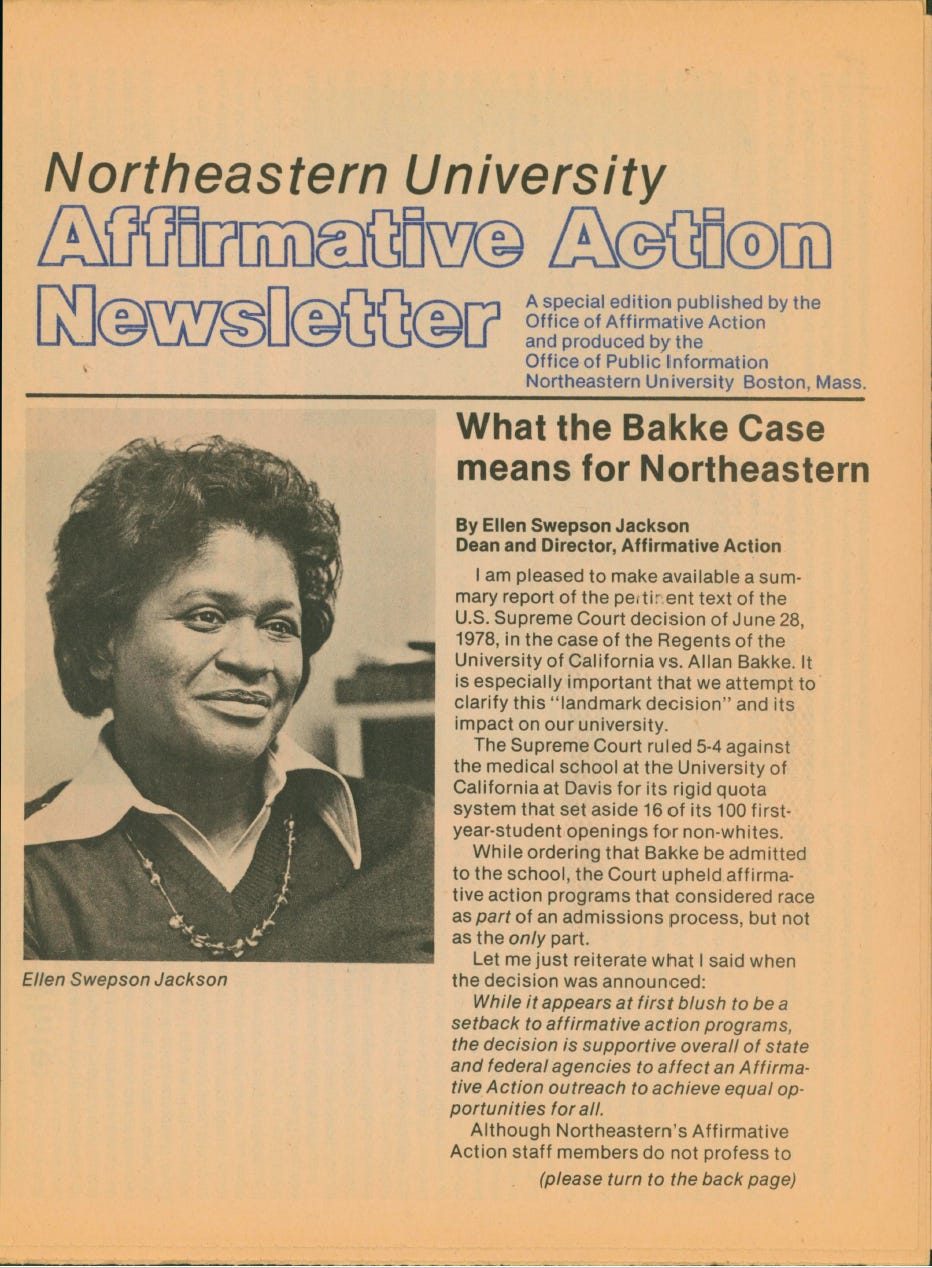
The story doesn’t even start with Blum first attempting to eliminate affirmative action by backing his white plaintiff in Fisher in 2012, nor with his backing of the Shelby County v. Holder case a year later that effectively overturned a key provision of the landmark Voting Rights Act of 1965, one that was meant to protect historically marginalized voters in jurisdictions with histories of racial voting discrimination. Is the starting point, perhaps then, the landmark Regents of the University of California v. Bakke case in 1978 that effectively set the narrow precedent for affirmative action on the basis of compelling diversity interests that we would see maintained for the next forty years? I ask these questions not to posit a “right answer” for locating a specific origin point as to when affirmative action and race-conscious policies became a divisive and contested issue in the US landscape, but to instead draw our attention to the long, messy history of mediating Asian Americans in the ideological project of race construction and reification.
“Northeastern University Affirmative Action Newsletter,” The Office of Affirmative Action and Diversity Records. Collection A068, Northeastern University Archives and Special Collections, Northeastern University, Boston, Massachusetts Box 2, Folder 2.
Because as the story turns out, Blum was extremely successful in gathering a coalescence of Asian American students, and their parents, who felt that there was an unfair racial quota system in place inhibiting them from gaining acceptance to Harvard despite their high “stats”—thus the nonprofit Students for Fair Admissions, or SFFA, was born. The case of one poster child for Blum’s campaign in 2013, Michael Wang, is particularly insightful: “with near-perfect test scores, stellar grades and a pages-long resumé of extracurricular activities,” he wanted to know why the colleges he had applied to had rejected him, and how much race had to do with their hidden admissions process. Despite claiming to not be “anti-affirmative action” (he apparently just wants it “reformed”), Wang’s story was repeatedly shared in the never-ending slew of media coverage on the SFFA case, along with his then-explicit belief that colleges were wrongly using affirmative action to “help some historically marginalized students but disadvantage others.” The implicit subtext that emerges here—essentially that race-conscious policies benefit Black and Latinx students at the expense of Asian Americans—is not unique to Wang’s viewpoint, nor does this new framework emerge in isolation.
We see it emerge countless times throughout the decades-long mainstream media coverage of the case, but also fascinatingly imbued in the site of the digital content creation realm. Months before the SFFA ruling but still in the thick of the case, Jay Caspian Kang, a Korean American writer who is by now well known as the intellectual media representative of all Asian Americans and Asian American topics, wrote a short piece for the New Yorker on a new and particular content creation market of students, “stats,” and the anxiety of college admissions. Detailing the thousands of videos on TikTok of young students attempting to make sense of their inability to gain acceptance to institutions like MIT or UCLA despite their entire lives spent working towards nothing else—and with the stats to prove it—Kang’s piece is particularly analytically harrowing when he focuses on one Asian American content creator, a sophomore at Duke University, whose TikTok account is dedicated to predicting where his followers will gain admission to based on the stats they’ve sent in to him. Kang writes:
It should come as no surprise that Lim and many of the people who post these despairing videos are Asian American. The anxiety that underlies these videos and the popularity of Lim’s version of real talk—he has more than a hundred thousand followers on TikTok—come from the growing consensus among Asian American families and their teen-age children that these colleges do not want them on their campuses, regardless of their accomplishments.
Earlier this year, Lim posted a video about the racial makeup of admitted students at Harvard and Yale. He did the math that’s become almost gospel in a lot of Asian households and noted that fifty-six percent of African American applicants in the top decile get into Harvard, compared with just thirteen percent for Asian Americans. When one looks at the chart, Lim explains, what becomes clear is that you can be a Black student in the bottom forty percent of applicants and have the same chance as an Asian American student in the top ten per cent.
Not dissimilar to the young students who make these videos in the first place, the underlying subtext of Kang’s piece—while right to address the despair that youth are feeling in the neoliberal education system and labor market—is that the despair, once again, comes from an unfair system that privileges Black students at the expense of Asian American students, meritocracy be damned. In the immediate wake of the official ruling overturning decades of affirmative action precedent and ten years after he was first recruited for SFFA, Wang admitted that part of him regretted his role in the anti-affirmative action movement and that he “did not understand the magnitude of the situation… until the Supreme Court shifted to a conservative majority.” To this day, it is clear that Wang, who is now in his late twenties, still does not hold a firm position on affirmative action. Nonetheless, his critical role in the mobilization and coverage of the case illustrates the broader convergence of conservative Chinese—and Asian writ large—immigrant advocacy groups (like the Asian American Legal Foundation and 80/20) with a more traditional coalescence of white nationalism, to ultimately stand in for all Asian Americans.
This new racial framework hasn’t emerged in isolation precisely because throughout the decades-long legal process, a critical aspect of SFFA’s strategy in their broader goal of dismantling race-conscious policies and ideology writ large was its repurposing and recalculation of the beneficiary/victim. If the framing was once that affirmative action policies benefited Black and Latinx students at the expense of whites, SFFA’s injury claim and legal framework strategically shifted the framing to such policies benefiting Black and Latinx students at the expense of Asian Americans—making it harder to legally justify an already-precarious rationale. Understanding this strategic shift is crucial to understanding the long-term implications that the overturning will have, and indeed already has started to have, on cross-racial solidarity and relations between Asian and Pacific Islander Americans and Black and Latinx Americans.
To be sure, the theorization of how Asian Americans have always occupied a mediary position in the Black-white binary of the US racial hierarchy is not a new one, and scholars like Dana Takagi (1992) and Mari Matsuda (1996) have written powerfully on how affirmative action jurisprudence is an imbued site for positioning the group as the “racial bourgeoisie.” And while it is not the point of this piece to re-argue and re-articulate that this notion of Asian Americans being injured by affirmative action at the alleged “benefit” of Black and Latinx students, must be reevaluated as a fallacy and more importantly, as a strategic attempt by the white hegemon to preserve whiteness at institutions that can otherwise provide powerful elevating opportunities for people of color, I start from this point of analysis to ask how the SFFA case has marked a new temporal demarcation in our collective understanding of what it means to have race-conscious admissions in a US order predicated on anti-Blackness and mediated through Asian Americans.
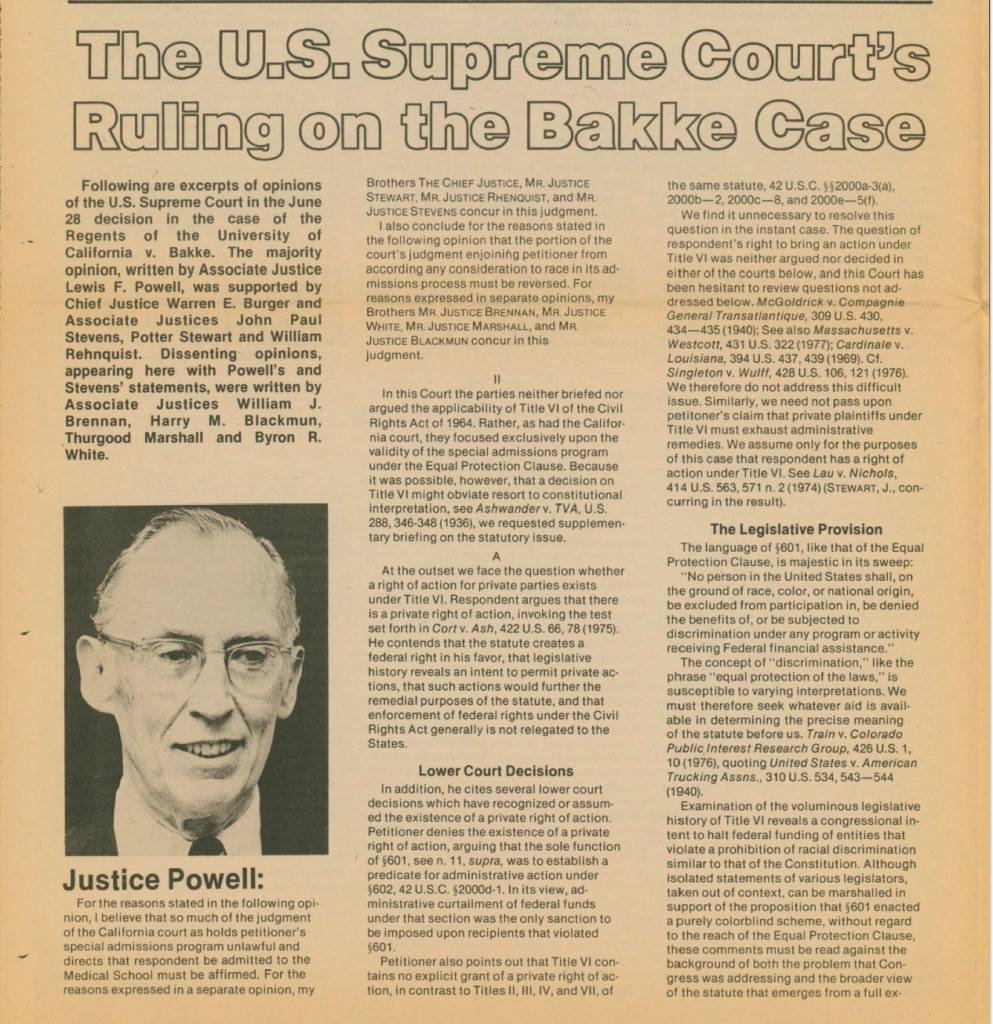
Indeed, Claire Jean Kim has already done the work of tracing for us how Asian Americans have been mediated in this racial framework since Bakke. She stunningly traces the language in Justice Powell’s opinion for Bakke, who configures Asian Americans (or “Orientals,” written by Powell’s clerk) as “spoilers”—an ethnic group that has also been subject to racial discrimination, thus complicating the question of which historically marginalized group “deserves remedial consideration” in the question of affirmative action. In other words, “if Asian Americans are a ‘minority’ and thus discriminated against… how are they able to gain admission in ‘large numbers’?” (Kim 2018, 6). Is the answer here purely based on merit? Before one answers this question, they must first note how Powell invokes a sociometry that denies the structural order of group positionality as predicated on anti-Blackness, instead believing in an entirely unitary concept of discrimination that obscures the differentiated positionings of non-white groups in the social order.
This means that to Powell and his clerk, all minorities are literally the same, and hold the same amount of power, and face the same challenges—allowing for an apolitical and ahistorical analysis that invokes Asian Americans to not only de-specify anti-Blackness in the US, but to effectively delink affirmative action from its original remedial rationale for one that instead focuses on the arbitrary purpose of “diversity.” Then, the question from before—on whether Asian Americans have actually been able to gain admission despite facing discrimination due to true meritocracy—becomes obsolete, because as Kim states for us: “[T]he question of how Asian Americans are succeeding despite discrimination—’How do they start out in the same place as Blacks and end up farther ahead?’—is not on point. A better question is ‘How are Asian Americans positioned differently from Blacks in the social order such that the specific advantages, immunities, and burdens that emerge from this position shape their group outcomes relative to Blacks?’” (Kim 2018, 10). If one is actually able to untangle the legal (il)logics that frame affirmative action jurisprudence, it is possible to see how conservative members of the federal judiciary use the law to shape the opportunity outcomes for certain ethnic groups over others, but above all keep outcomes in the hands of the white elites.
“Northeastern University Affirmative Action Newsletter,” The Office of Affirmative Action and Diversity Records. Collection A068, Northeastern University Archives and Special Collections, Northeastern University, Boston, Massachusetts Box 2, Folder 2.
As scholars at the intersection of law and critical race studies have extensively written out for us, race is not only made real through the law, but racial categories and meanings profoundly shape the distribution of goods in society. Beneath the “contemporary edifice of prima facie racially neutral laws and policies” via colorblindness, Kim illuminates for us, is a system that continues to obscure patterns of white racial domination first and foremost through the racial triangulation of Asian Americans vis-à-vis Black and white Americans. Taking us through the arrival of Asian migrants to the US in the mid-nineteenth century to the cosmetic changes of the post-1965 civil rights era, Kim shows us how white elites have always positioned the racial category of Asian (immigrants) as superior to Black (enslaved) for the narrow and temporary fulfillment of labor exploitation, but forever foreign and unassimilable to whites. The fact that Asian Americans have always been situated at a particular conjecture between white supremacy and Blackness is thus a priori to the way the group has been configured in affirmative action jurisprudence by conservative legal groups and a new contemporary formation of white (and Asian) elites—the latter cannot exist without the former. While the deconstruction of colorblind ideology and its dangers is permeated throughout interdisciplinary scholarship examining the intersection of race, law, and narratives in the US context, I note here that like Cheryl Harris, who argues that colorblind ideology is the contemporary enshrinement of the property interest in whiteness, Kimberlé Crenshaw also addresses the project of colorblindness as not a mere matter of policy, but as “installing a particular orientation towards inequality itself” (Crenshaw 2007, 126).
While the SFFA decision was a new landmark victory for the conservative project, Blum has actually filed over two dozen cases since the 1990s with the mission of removing the very concept of race from the US legal system. Here, we must be reminded that “legal rhetoric functions as a regime of truth and power.” And if there is anything we must learn from the deep, historic connection between Justice Antonin Scalia’s version of textualism—the dominant method of statutory interpretation amongst the federal judiciary—and his father Salvatore Scalia’s leading approach to New Criticism, it is that form invariably elides into politics. As an “empirical, formalist approach to literary criticism,” the New Critics argued for a kind of criticism that would purportedly be objective, scientific, precise, and systematic, and it is precisely this methodological approach to that would go on to inform law and legal interpretation as predicated on a bounded notion of scientific objectivity. In other words, Blum’s project to “remove the concept of race” from the legal system, and to move towards the ideology of colorblindness instead, cannot be treated simply as an act of removing textual language from legal interpretations or legal frameworks; it must be treated as an ideological project of shaping our collective conception of power (who has it and who doesn’t), in order to materially keep power in the hands of those who get to determine what the law is and how to apply it selectively.
I continue to look to the site of the law and the legal realm to respond to the question: What has the racial logics embedded within the Students for Fair Admissions, Inc. v. President and Fellows of Harvard College case, and its official ruling last year overturning decades of race-conscious precedent, done to the ongoing figuration of Asian Americans in the legal-ideological project of colorblindness? How are racial subjectivities changing in accordance, or perhaps in opposition, with this ongoing, contemporary legal-ideological project of eliminating race-conscious policies and theories writ large? Due to the fact that the ruling took place only last year, scholarship on the case and its profound effects on US racialization remains limited to the actual duration of the case but before the 2023 ruling overturning decades of affirmative action precedent. Moreover, as I have articulated, scholarship has already looked to affirmative action case law and jurisprudence for theorizing Asian American mediation. My analysis remains within the legal realm because I believe the law is a critical and imbued site for thinking about how configurations of race are naturalized and legitimized through the law, but also for thinking about how race remains intertwined to a bounded notion of scientific, empirical objectivity through the law. If race is made real through the law, the law is what continues to reify it.
I employ a historicization and legal analysis of US Supreme Court cases from the 1920s that are indeed not about affirmative action policies (which were enacted and formalized in the 60s and beyond) but have already taken up the injury claims and themes that would later be imbued in affirmative action jurisprudence: ideas contesting race and the material benefits that are only accrued to certain categories of race, namely whiteness. As we shall see in the following three cases—Ozawa v. United States (1922); United States v. Bhagat Singh Thind (1923); and Gong Lum v. Rice (1927)—there are real material, vested interests only afforded to and protected by whiteness, explaining why these Asian American plaintiffs worked to legally contest the nation-state’s ill-defined, unstable definitions of whiteness. As these plaintiffs claimed to be white and the US in return argued against such claims, we are able to witness the procedural and dialectic relationship between Asian Americans and the state, and how both parties situated Asian Americans in relation to whiteness, but also Blackness. I believe that this legal-historic analysis—tracing the material relationship between race and the law to situate how Asian Americans have always been depoliticized and configured at a particular conjecture between white supremacy and anti-Blackness—provides an analytic pathway to understanding the contemporary moment in which the SFFA ruling has once again, placed Asian Americans at the same conjecture. Indeed, now this configuration and depoliticization is more tailored to the legal-ideological project of colorblindness, subsumed in and through the discourse of meritocracy and assimilation.
Jesica Bak is the editor-in-chief of Illume Magazine.
As the state-sanctioned assault on the reproductive rights movement continues, legal mechanisms and healthcare institutions are furthering racialized disparities.
By Ella Chin
DEC 21, 2024
During the most recent 2024 term, the Supreme Court heard two critical, but less-well known, abortion protection cases. In FDA v. Alliance for Hippocratic Medicine, the Supreme Court ruled that the four pro-life medical associations, and several individual doctors, did not have the standing to challenge the constitutionality of the FDA’s approval and regulations for the widely-used abortion medication, mifepristone. The Court’s June 13th decision reversed the previous instated injunction, allowing the medication to remain accessible on the markets. The Court, however, issued no decision on whether or not the FDA’s regulations were, in fact, legal.
Only two weeks later in Moyle v. United States, the Court reinstated the lower court’s decision that the state of Idaho cannot constitutionally enforce its restrictive law that criminalizes abortions to the extent it conflicts with the Emergency Medical Treatment and Labor Act, or the EMTALA. Despite this temporary protection for abortions, the Court ultimately dismissed the case and the clash between EMTALA and Idaho’s abortion laws remain, illustrating a broader complication of navigating state and federal regulations for abortion that hinders patient accessibility.
Above all, the cases illustrate that even after the Court issued the detrimental decision Dobbs v. Jackson in 2022(which overturned Roe v. Wade, the landmark 1973 decision that instituted the federal right to an abortion), it is clear that the battle to eliminate existing protections for reproductive rights continues. The overturn of Roe v. Wade was far from the worst of it.
The breadth of the advocacy groups that submitted amicus briefs to the Court for Dobbs v. Jackson—The National Asian Pacific American Women’s Forum (NAPAWF), Asian Americans Advancing Justice (AAJC), and Puerto Rican organization Nacional Por El Aborto Libre (National Campaign for Legal, Safe, and Free Abortion)—demonstrates the far reaching stakes for reproductive justice. According to 2021 data from the Pew Research Center, 42% of all women who had abortions in the District of Columbia, New York City, and 31 other states were non-Hispanic Black and 22% were Hispanic. The International Journal of Environmental Research and Public Health found that in New York City, the abortion usage within the Asian American community had not decreased compared to other racial groups from 2011 to 2015. In fact, the abortion rate for Indian women was roughly three times the average for the overall Asian American community sampled.
Despite these facts, the mainstream reproductive rights movement has historically been fronted by white women. In 2021, the National Committee for Responsible Philanthropy found that predominantly white reproductive rights organizations make up the top 20 recipients of funding for the cause. This is a glaring problem. There cannot be a successful and complete fight for reproductive rights as long as cultural, economic, and racial barriers effectively exclude communities of color and their experiences. Reproductive justice is intertwined with racial justice.
However, a multitude of cultural and racialized barriers remain unheard and unseen in the fight for reproductive rights. For example, language barriers place a significant burden on individuals of color in navigating the complexities of individual state abortion bans. The amicus brief submitted by both the NAPAWF and the Asian Americans’ AAJC for Dobbs v. Jackson cites that “over one third of Asian Americans report limited English proficiency” and that the AAPI community consists of over 100 languages and dialects. According to a 2024 study by the Kaiser Family Foundation, 26% of Hispanic women ages 18-49 and 10% of Native Hawaiian and Pacific Islander women speak English “less than very well.” Within the context of a healthcare system that already perpetuates inequality and inaccessibility for subordinated peoples, women of color are increasingly facing new and particular barriers to becoming informed of ever-changing restrictions.
The intersection between US racial stratification and economic disparities also undeniably bars adequate access to healthcare and reproductive services for women of color. According to the amicus brief submitted by the National Women’s Law Center for Moyle v. United States, Asian Americans, Native Hawaiians, and Pacific Islanders, Black, Indigenous, and Latinx populations are significantly more likely to be uninsured than their white counterparts for healthcare. In addition to being uninsured at higher rates, in the same amicus brief, the NAPAWF reported that “on average, AAPI women working full-time are paid 85 cents for every dollar paid to their white male counterparts,” illustrating not only accessibility, but affordability as an economic hurdle to overcome for access to care. These disparities remain unseen in the greater movement for reproductive justice, but individual state abortion regulations are further perpetuating these economic disparities. For the oft-conflated and homogenized AAPI community, the model minority myth further conceals the economic disparities that bars them from abortion and reproductive care, disregarding the community’s stakes in the fight for reproductive justice.
This October in Houston, Texas, Josseli Barnica experienced a miscarriage at 17 weeks, which put her at risk for an infection if the hospital did not perform an abortion or empty her uterus. Due to the state’s abortion ban, medical professionals could not perform any procedure for Barnica until the heartbeat of the fetus stopped. Days after her delivery, Barnica died from a sepsis infection. Barnica’s case illustrates greater complications in the movement for reproductive justice. Not only are medical professionals in states with abortion bans now confronted with the legal bind of compromising their medical integrity or possibly facing prosecution, but the legal ability to provide an abortion—and therefore prevent a woman’s potential death—is entirely dependent on the state. Had Barnica been in another state where abortion bans were legal, her death could have been averted. But not all women of color have access or means to travel out of state for abortions. Given that some communities of color already have higher rates of abortion compared to their white counterparts (due to limited access to contraceptives and healthcare), the lack of resources to travel creates a compounding of inequalities such that women of color are both disproportionately in need of, and unable to access, abortions. It is clear that without first recognizing the clear economic hurdles people of color confront, access to abortion and healthcare will remain dangerously inequitable.
In thinking about the need to decenter whiteness from the ongoing fight for reproductive rights, we must also remember that the United States has always weaponized the control of women of color’s bodies as a vehicle to perpetuate white supremacy and systemic oppression. Many of the Supreme Court’s decisions reflect the country’s roots in eugenics, most notably when the Court upheld forced sterilization of “unfit” individuals in Buck v. Bell (1927). In this case, the Court reasoned that the Virginia statute that authorized sterilizations was for the welfare and best interest of society. The same legal doctrine was later used to justify government-funded “family programs,” that pushed compulsory sterilization of roughly 100,000 BIPOC women who were seen as “unfit” to reproduce. In other words, these sterilizations were in the “best interest” for society. In reality, these policies and legal mechanisms were grounded in the view that minority populations are so deeply inferior that their existence, and continued reproduction, are a blight on society, one that threatens the structures of the human race (the white race).
The government continues to justify the policing of non-white bodies under the guise of what is best for society (white domination) even today. Similar mechanisms used to enforce abortion bans are rooted in racist and discriminatory stereotypes against communities of color. One example is sex-selective abortion bans, which prevent individuals from seeking an abortion on the grounds of sex of the fetus. Within the past decade, several states including Arizona, Illinois, Kansas, North Dakota, and North Carolina enacted sex-selective abortion bans and others continue to evaluate bills for these bans. Harmful Asian stereotypes (mainly that Asian cultures favor sons over daughters, and that Asian women are more likely to get abortions if they predict they will give birth to a girl) justify such bans. Former South Dakota State Representative, Stace Nelson, on considering South Dakota’s sex-selective abortion ban said, “Many of you know I spent 18 years in Asia, and sadly I can tell you that the rest of the world does not value the lives of women as much as I value the lives of my daughters.” What this rhetoric does is reinforce stereotypes veiled as what is “best” for women while also upholding the structures of white supremacy through the control of non-white bodies. Enforcement of these bans are just one way to criminalize the pregnancies of individuals in the AAPI community and prevent their access to abortion care.
At this point, it is worth noting that the two cases from earlier this June—FDA v. Alliance for Hippocratic Medicine and Moyle v. United States—each had a key element in their rulings: the Supreme Court did not rule on the constitutionality of these abortion protections. As Justice Ketanji Brown Jackson wrote in her dissent for Moyle, “[the] decision is not a victory for pregnant patients in Idaho. It is delay. While this Court dawdles and the country waits, pregnant people experiencing emergency medical conditions remain in a precarious position, as their doctors are kept in the dark about what the law requires.” This paints the greater implications for the two cases: any existing abortion protections—at the state and federal level—remain in jeopardy. Mifepristone and emergency abortions required by the federal government may present themselves again before the Court, standing on the chopping block of the conservative majority. There is nothing stopping another party from challenging these protections (as all it takes is for them to prove standing) and the conservative Court from striking them down. The movement for reproductive justice cannot afford, while the assault on abortion protections continue, to ignore the experiences and challenges of minorities and people of color. The Court will continue to hear cases that endanger protections to reproductive rights, so to ensure that the fight for reproductive rights is successful, it is imperative we remove the cultural, economic, and racial barriers for abortion care.
Ella Chin is a philosophy and economics major at Northeastern University.
The transnational “Hallyu!” exhibit is not a celebration of South Korean history and culture, but instead reinforces the illusion of postcoloniality and the logic of Western modernity.
By Jesica Bak
MAY 08, 2024
Photo by Jesica Bak.
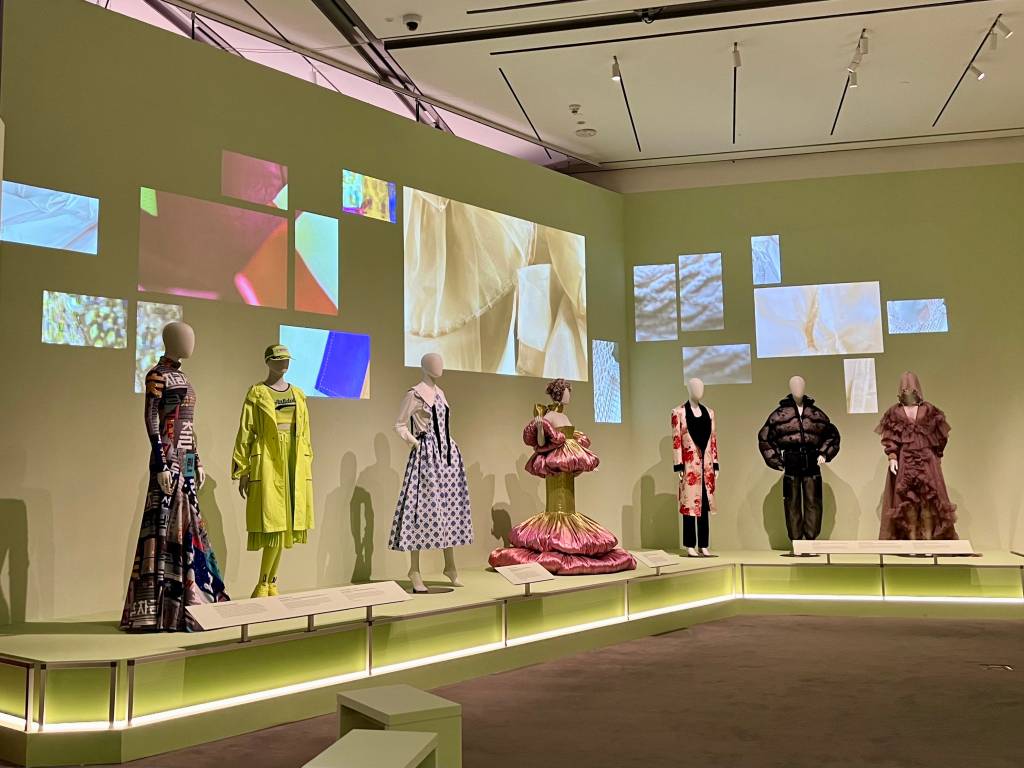
Immediately upon entering, the spectator is introduced with flashy TV screens playing PSY’s “Gangnam Style”; upon further entering, a room full of even flashier, neon-colored outfits worn by generations of K-pop idols on stage, all displayed on mannequins standing on two levels of a futuristic platform. On the wall, a giant screen playing K-pop girl group Aespa’s “Next Level” reminds me that the song was globally popularized by opening for the Wild Rift SEA Championship Grand Finals in 2021. A wall dedicated just to light sticks famously known for being waved around by fans at K-pop concerts. More walls displaying advertisements of Korean actors posing for skincare, posing for Chanel—labeled as a celebration of “genderless beauty.” A poster of the 2009 K-drama Boys Over Flowers that set the stage for positioning Korea within soft masculinity and male aesthetics. Right next to the poster is artist Hwang Eul-Jip’s photo-based depiction of Korea’s cosmetic surgery industry. Hanbok turned into Haute Couture. An intricately constructed replica of the bathroom in Bong Joon-Ho’s Oscar-winning film Parasite.
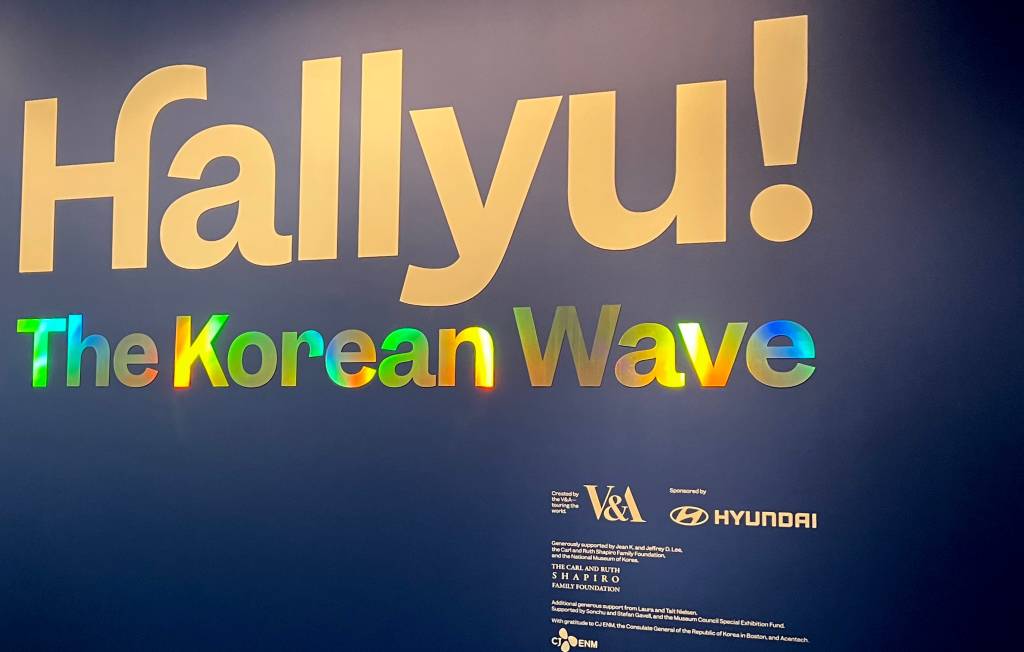
In March, the Museum of Fine Arts, Boston opened its doors to “Hallyu! The Korean Wave.” Already making headlines for celebrating South Korean cultural exports, the exhibition originates from the Victoria and Albert Museum in London and is soon opening doors in San Francisco. Unsurprisingly, the transnational project is sponsored by the Hyundai Motor Company back on the peninsula, whose press release of the exhibition writes that “Hallyu—the fruit of Korea’s rapid political, social, and economic growth on the back of the enduring US–Korea alliance—stands as a testament to the power of global collaboration and friendship.”
But by now, it should be clear that not only is the exhibit devoid of any actual art, but that perhaps its function is not really to “weave the past and the present” by tracing “the country’s meteoric rise to the world stage… [as] the story of remarkable resilience and innovation”—as the exhibit’s own taglines may want you to believe.
If it is, it has failed miserably; the space in all of its materiality fails to delineate history, fails to offer spaces of political critique against questions of the nation-state, of war and empire, and succeeds only in presenting Korea not as a nation and people with a nuanced history affected by the hierarchies of geopolitics but as an Otherized symbol of soft power, something for the West to gaze upon in bizarre fascination, a series of commodities upon more commodities. Rather than challenging the Western cultural imagination’s habit of relegating South Korea to this handful of cultural commodities, the MFA decided to further spectacularize the nation by showcasing 250 material objects related to K-hyphenated consumption, consumerism, and aesthetics in late stage capitalism.
Posters of popular South Korean films that helped globalize the nation. Photo by Jesica Bak.
Paired with a handful of archival photographs and postcards from the Japanese occupation, the exhibit’s pathetic attempt at briefly delineating Korean history is summed up by their didactic text titled “From Rubble to Smartphones,” narrating:
As a country ravaged by war in the late 1950s to a leading cultural powerhouse by the early 2000s, South Korea has experienced a dramatic rise. Its remarkable trajectory from “rags to riches” is marked by governmental control, daring strategies, and IT innovations paired with a ppalli-ppalli (“quick-quick”) ethos, where speed is of the essence… This compressed modern history and hybridity contributed in shaping hallyu.
Such language not only apolitically attempts to rewrite history as if South Korea and South Koreans were able to—with a winning combination of luck, meritocracy, and U.S. aid—transform themselves from a war-torn, rubbled country to the rich, industrialized, globalized powerhouse they are today, but manages to obscure, first and foremost, the question of who exactly ravaged the country with war in the ‘50s.
In fact, not once did I take note anywhere throughout the exhibit, which purportedly claims to weave the past with the present, of a history that accounts for the U.S. casting the very die for the foreboding Japanese colonization of Korea by brokering a 1905 deal that, in exchange for ensuring that Japan would not question “American rights” to the Philippines, the U.S. would not challenge Japan’s right to establishing a protectorate of Korea. Already emulating racist ideologies spread by American missionaries in the East, Theodore Roosevelt won the Nobel Peace Prize for this diplomatic colonial trade-off.
There is no history accounting for the U.S. neglecting Korean exclusion from the liberation process; the U.S. partitioning the two Koreas at the 38th parallel and claiming control of the southern half; even after the physical removal of Japanese empire in 1945, no accounting for the U.S. military government’s institutionalization of education and cultural policies that reinforced the colonial Japanese education system; for the U.S. authorization of the 1980 Kwangju student massacre as well as its proceeding anointment of the orchestrator of the massacre, Chun Doo Hwan, to South Korean presidency; no less its ongoing neocolonial occupation of the South Korean nation-state that remains officially pro-American despite remaining under its militaristic and economic thumb. (There is one line of didactic text from the exhibit aligning a men’s skincare advertisement from 1974 to “the ethos of President Park Chung-hee’s patriarchal military regime and the image of macho men projected by Hollywood films in 1970s Korea.”)
Thus, not only is there no art present in the MFA’s “Hallyu!” exhibit, but there is no possible space for viewers to critique U.S. empire and its role in the state-building process of South Korea—one that was not made attractive with idols and cosmetics, but rather worked in tandem with the political elite of the former colony to further subjugate the Korean people under the patronage of the Cold War powers. The language of the museum is not an accident nor a coincidence, for it is in these kinds of cultural spaces wherein we can locate the narratives of the state that further elude and mystify the internal displacement of a postcolonial South Korean nation today, as well as its contested epistemological landscape.
Mannequins displaying “the rise of K-fashion.” Photo by Jesica Bak.
In other words, it is precisely these kinds of cultural narratives and spaces that function on behalf of the state to position the Republic as a successfully decolonized, postcolonial nation—we must remember that for the MFA, only a country that is postcolonial can be “a country [once] ravaged by war in the late 1950s to a leading cultural powerhouse by the early 2000s.” As such, a crucial part of this successful postcolonial imaginary in South Korea, amongst Korean diaspora, and in the international order writ large, is predicated on the nation’s economic industrialization, political democratization, and transformation into the global and cultural hub it is today. Underlying such language is also the illusion that the logic of Western modernization and globalization brought both economy and democracy, and thus postcoloniality, to the Republic of Korea.
In his timeless 1993 critique of the epistemological landscape of South Korean postcoloniality, Chungmoo Choi writes in “The Discourse of Decolonization and Popular Memory: South Korea,” that this narrative is not only predicated on Koreans’ exclusion from the liberation process, but illustrates what he calls a “colonization of consciousness”—an illusion that the (formerly) colonized live in the same social and cultural sphere as that of the metropolis, and attempt to emulate as such through cultural expression, values, behavior, and the production of knowledge. For Choi, the transitive verbs “to liberate” and “to partition” presuppose a differential positionality between subject (who administers the action) and object (the passive receiver upon which such actions are performed). The “Hallyu!” exhibit, in all its soft power glory, is not a celebration of South Korean culture and nationhood, whatever that may entail, but rather reinforces what Choi warns us of: “that is, while the absence of the real remains uninterrogated, the colonial discourse will continue and colonialism will continue to be reproduced.”
Jesica Bak is the editor-in-chief of Illume Magazine.




 illume magazine