
What does it mean to internalize a prejudice against Chinese Americans that we must distinguish from the conflated narrative of discrimination against Asian Americans writ large?
By Jason Tung
MAY 02, 2024
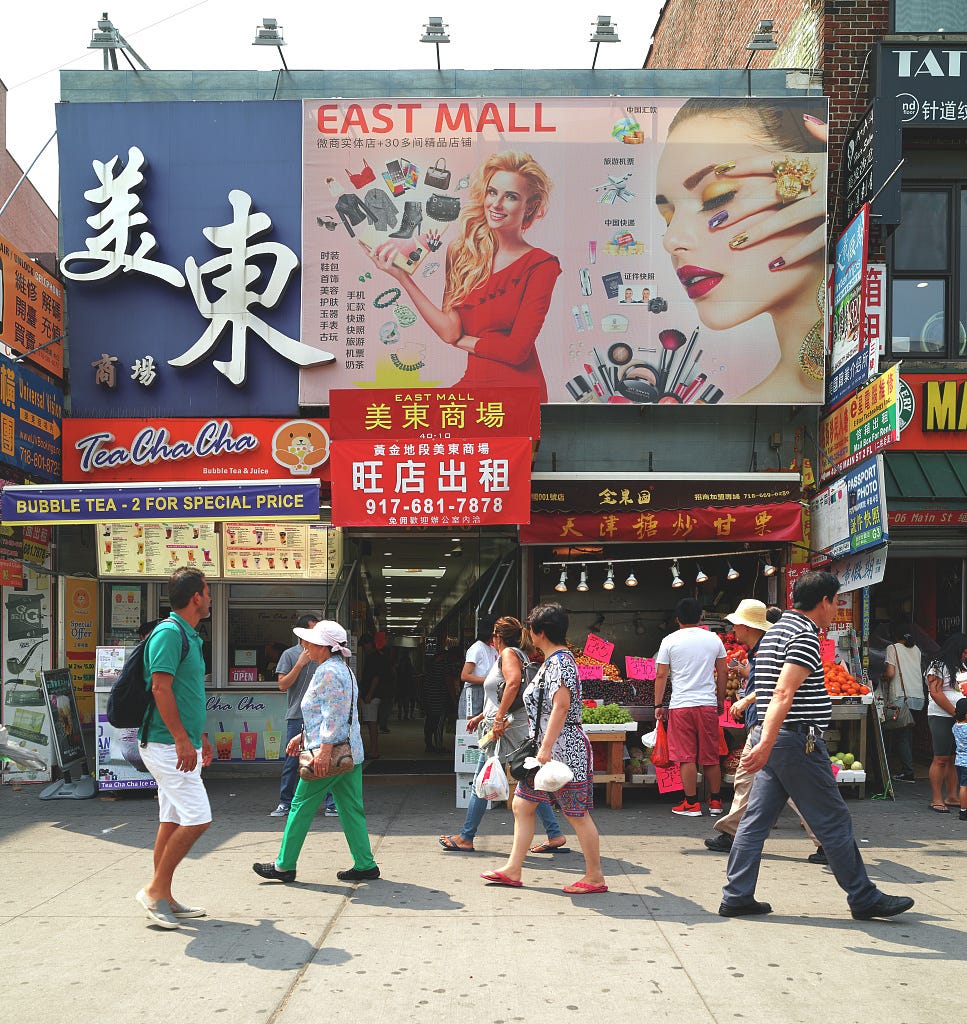
Even before I could articulate it, I felt the different political and economic realities afforded to my community. I grew up in Flushing, New York, a city with a very sizable Chinese working-class and immigrant population—almost half of Flushing’s population is Chinese and the median income in downtown Flushing, where most of its residents are foreign-born immigrants, is a mere $25,000.
My parents worked long hours and often on weekends, our house had dead rats stuck to adhesive traps every morning, and many of my fellow Chinese classmates couldn’t afford to buy enough notebooks for the school year. In the little time my parents shared with me, they spoke to me in Chinese, cooked me Chinese meals, and we celebrated Chinese holidays. But to someone who knew nothing else about the world, this wasn’t what it meant to be Chinese—this is just what life was. And yet, I grew up internalizing a very real prejudice against Chinese Americans that we must distinguish from the conflated narrative of discrimination against Asian Americans writ large.
In the 19th century, some of the first Chinese immigrants were brought to the United States as labor for the first transcontinental railroad, a chronicle of American imperialism that is historically and actively erased. As Manu Karuka writes in Empire’s Tracks, “To be a Chinese worker on the Central Pacific was definitively not to be a slave, the property of another. It was, however, a reduction to the status of a tool for grading earth and drilling a mountain. It was to be expendable, interchangeable, replaceable.”
The compulsory and exploitative nature of importing and reproducing Chinese laborers created unlivable wages for white Americans within California, rendering the Chinese monolith as a scapegoat for the landscape of American racial politics. And these sorts of cultural ethics inform the discriminatory laws and policies that serve to reinforce the harmful narratives that inspired them to begin with, creating a cycle of state-sponsored racism. As such, the Chinese identity in America today is hallmarked by a long history of formalized racial violence and humiliation. Historicizing Sinophobia sheds light on how Chinese Americans view their ethnic identity as well as their identity and value as individuals. From when we are as young as we can remember, we are taught to question our heritage and whether it’s something worth celebrating.
The ubiquity of the internet further shaped my understanding of Sinophobia in its representation in popular culture. My peers loved to discuss and consume Japanese and Korean media—their shows, their music, and their idols. When I played games online, it was common practice for players to use Japanese and Korean characters in their names or their favorite anime character or K-pop idol as their avatar, while very clearly not being Japanese or Korean themselves. But at the same time, Chinese media and culture never saw the same love, except from the occasional Chinese person. My experience seeing so many other Chinese people, myself included, falling in love with other East Asian cultures besides their own inevitably led me to internalize the idea that Chinese culture was simply boring, uncool, and undesirable—because surely there is something that makes all the Chinese kids around me flock to K-pop and anime.
As a result of the popularity of Japan and South Korea’s cultural exports and their political affinities with the United States, to be Japanese or Korean has become aspirational for many individuals, manifesting as a kind of blind-siding soft power that’s omnipresent online. Take, for example, Chinese makeup styles: it is common practice for Western social media users to repost makeup tutorials from Xiaohongshu, a Chinese equivalent to Instagram, onto other platforms and label it as “Korean” or “Japanese” instead, pointing toward a broader cultural distaste for China while simultaneously revering the West’s near-fetishistic virtue of being Japanese or Korean. This phenomenon extends beyond makeup, to the point where all varieties of Chinese media are attributed to either Japan or Korea.
Such aversion to giving China credit for its cultural productions can be explained by a history of Sinophobic indoctrination in not only America, but the West as a whole. While Chinese bodies were being devalued, exploited, and racialized for the construction of the Central Pacific railroad, anti-Asian sentiments were simultaneously and violently propagated. Through the racist and colorist metaphor of Yellow Peril, East Asians were painted as primitive, lesser, and hazardous to the Western world, but the growing Chinese population in the U.S. became specific subjects to Anti-Coolie taxes and the Chinese Exclusion Act, spelling out an ethos hostile to anything Chinese.
But growing up in America means continuing to learn and implicitly endorse Western historical accounts. There is very little room in the American educational system to think critically about what we are taught and in many cases, our education and media tell us how to think. After all, only 1.5% of Americans are Chinese, meaning the vast majority see little reason to oppose narratives that do not impact them. Beyond the insidious nature of historic oppression and discrimination pervading education and media, we might also confirm the continued prejudice against the Chinese diaspora with the age-old, blatant racial stereotypes: mocking Chinese people for eating dogs and cats, for their social credit scores, working in factories, censorship.
Of course, what the Chinese government does is neither inherently connected to the Chinese nationality nor to those of Chinese heritage spread across the global diaspora. How are Chinese American youth expected to separate these dysphoric ideas when they are harassed with stereotypes and outright racism that paint their Chinese identity as a monolith and puts them on trial for the actions of a government they have no relation to? How are we to find the words to protest this kind of xenophobic double standard that white Americans certainly don’t hold themselves to? When censorship, militarism, corruption, poor living conditions, and inescapable foreignness are the things Western media readily associate with “China,” it’s clear to see why the average person is hesitant to give Chinese exports any praise. On the other hand, Korea’s government, for example, pumps undisclosed amounts of money to subsidize their media, translating their globally popular media into a de facto standard towards which Asians aspire.
When the U.S. COVID-19 lockdown took place, a surge of anti-Asian, and specifically anti-Chinese, sentiment and violence ran rampant. Misinformation about the virus, its transmission, and its relation to China and the Chinese diaspora revived decades of anti-Chinese prejudice and daily stories of wanton violence against Asians and Asian Americans; it was a frightening time to be Asian, and especially Chinese. The most frightening part was not that I or a loved one could be assaulted on the basis of bigoted misinformation, but instead the fact that it was so easy for the world to blame and enact violence against global Asian diasporic communities who had no connection to COVID other than looking like those who live in an East Asian country.
Without a face to blame for all the adversity of the pandemic, people made a boogeyman of the East Asian diaspora to cope with the hardships they faced and created echo chambers to propagandize and convert others feeling lost. With China already being viewed in a poor light in the Western world, the stage was set for Chinese people to take the fall for the global pandemic. And more than that, it reinforced what Westerners had long believed about the Chinese: that we are dirty, eat pets, and carry sickness.
It’s very easy and even natural to neglect our duty to challenge the narratives we are fed, from the news we watch to the corporations we buy from and the ethics we endorse. It’s an infinitely more difficult task to think critically about everything we are presented with; we often have the privilege to ignore narratives that ostensibly don’t affect us.
But in reality, such apathy serves to uphold the status quo, thereby harming minorities. It’s only through our unified efforts that we can fight against systems put in place by those in power, and against structural whiteness. And when we fail to address all harmful narratives against the racialized and powerless in the U.S., not only do they become pervasive instruments of societal harm, but it also sets a precedent that keeps minorities divided. As a Chinese American, my fight against Western narratives does not end with its racist attacks against the Chinese diaspora but extends to its persecution and subjugation of all minorities.
Jason Tung is a contributing writer based in Seattle.
 illume magazine
Leave a comment