
The sanitization of Israel–Palestine coverage spans from U.S. censorship to dangerous incitement of violence against journalists on the ground in Israel and Gaza.
By Juliana George
FEB 20, 2024
On Oct. 30, 10 days after he announced his departure from the Boston Globe, journalist and Pulitzer Prize finalist Abdallah Fayyad tweeted that an op-ed he had written about the war on Gaza was shot down by a higher-up at an unnamed publication. Fayyad said the piece was “not at all radical or incendiary or offensive” and simply advocated that Congress call for a cease-fire in Gaza in light of the staggering civilian death toll. Fayyad was not given an explanation for the decision, but to him, it wasn’t hard to imagine why the op-ed was rejected—he cited a “culture of fear in newsrooms” surrounding Israel–Palestine and also suggested the choice was likely related to his identity.
Fayyad, who is Palestinian American, opines that many Palestinian, Muslim, and Arab journalists face extra pressure to sound neutral on Israel–Palestine. More than that, he asserts that this standard is not equally applied to Israeli and Jewish American journalists.
“When you see a byline with somebody with a name like mine, you will assume that they are incapable of being objective on [Israel–Palestine] because of their background,” Fayyad said. “Meanwhile, our newsrooms have no problem citing Israeli newspapers and hiring Israeli writers and freelancers. It’s hugely lopsided which voices are elevated, especially in moments of crisis like this and especially in the early days of this particular war.”
The numbers don’t lie: in 2020, a +972 Magazinearticle found that just 46 of the 2,490 New York Times op-eds on Palestine since 1979 were written by Palestinians, equivalent to less than 2% (though the numbers have recently been increasing). But while Fayyad maintains that the issue of censorship on Israel–Palestine is more pronounced for Palestinian, Muslim, and Arab journalists, he also emphasized that the silencing of pro-Palestine voices in the news media is an industry-wide issue.
The sanitization of Israel–Palestine coverage spans from US-based news organizations that limit the free speech of pro-Palestine journalists to dangerous incitement of violence against journalists on the ground in Israel and Gaza. The phenomenon even extends to the sources and language that Western media organizations choose in relation to Israel–Palestine. Although most newsrooms allege that objectivity is their most universally held value, mainstream coverage of the war on Gaza tells a different story.
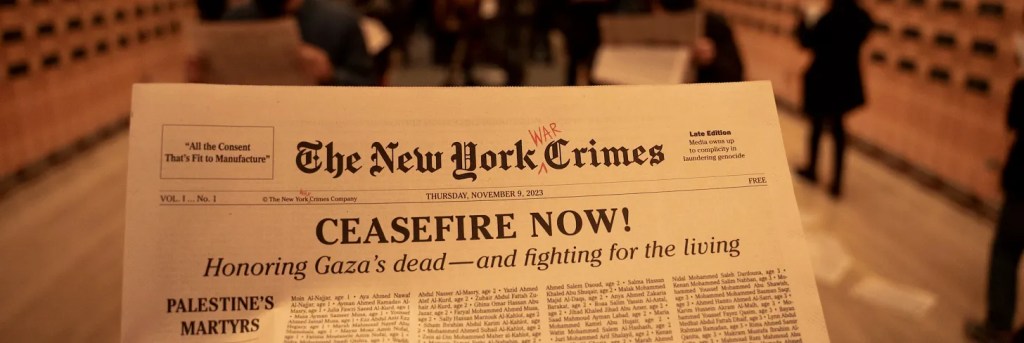
Fayyad is not the only journalist who has indicated his skepticism about how the mainstream media reports on Israel–Palestine. On Oct. 26, Writers Against the War on Gaza (WAWOG), a coalition of writers, journalists, academics, artists and other culture workers, published an open letter with more than 4,000 signatures condemning Israel’s genocide campaign against Palestinian civilians in Gaza as well as the mainstream media’s portrayal of the war. In another letter, published Nov. 9, more than 1,400 journalists denounce Israel’s killing of journalists and criticize Western newsrooms for unbalanced coverage.
Many of the journalists who signed these letters swiftly faced retaliation from their employers. One signatory of the WAWOG letter, award-winning New York Times Magazine staffer Jazmine Hughes, resigned from the Times under pressure from the publication’s editor-in-chief, Jake Silverstein. She said she was “largely denied [New York Times] Guild representation.” The New York Times Guild, part of the NewsGuilds of New York, represents over 1,400 editorial, tech, and media professional workers in the newsroom. Jamie Lauren Keiles, a contributing writer at the Times Magazine, resigned the same day in anticipation of similar disciplinary action given that his position did not have Guild protection. As media companies promptly reminded staffers of their social media policies—Hearst Magazines warned employees that “even ‘liking’ controversial content could result in their termination”—more than 30 journalists who signed the Nov. 9 letter have already removed their names in fear of retaliation.
At the Los Angeles Times, where nearly 40 journalists who signed the WAWOG letter were suspended from reporting on Israel–Palestine for three months, the ban disproportionately impacted Palestinian, Muslim, and Arab staffers. This prompted the Los Angeles chapter of the Council on American–Islamic Relations (CAIR-LA), a Muslim civil rights advocacy group, to send a letter to the Times’ executive editor, Kevin Merida, stating concerns about the possible effects on coverage of the war.
“While we understand the importance of newsrooms attempting to maintain impartiality, we believe that suppressing the voices of journalists who are directly affected by the events they cover is counterproductive,” wrote Enjy El-Kadi, digital communications manager at CAIR-LA, in an email. “This decision may strain the relationship between the LA Times and [the Palestinian, Arab, and Muslim] communities, potentially undermining the newspaper’s credibility as a source of information for diverse populations in Southern California.”
The question of whether journalists should be able to disclose their personal beliefs about the war on Gaza is part of a larger debate on objectivity that big names in journalism have been arguing about for years. Ever since newsrooms have begun to diversify, many—mostly younger—journalists have challenged the notion that objectivity was ever really present in journalism given the long legacy of discriminatory coverage toward marginalized groups.
Mari Cohen, an associate editor at the progressive Jewish magazine Jewish Currents who also signed the WAWOG letter, expressed exasperation that many of her fellow signatories were penalized by their employers in the name of what she dubbed the “so-called objective perspective.”
“Historically, this idea of journalistic objectivity has privileged a certain type of white male voice as the supposedly objective voice,” she said. “People who [speak] up for a less dominant perspective, for racial justice or for Palestinian liberation, [receive] more scrutiny.”
Conversely, a lot of journalists consider expression of personal beliefs in any capacity to run counter to the journalistic purpose. Al Tompkins, a senior faculty member at the Poynter Institute in St. Petersburg, Florida, advises journalists against all partisan statements, from open letters and social media posts to bumper stickers and yard signs.
“When you become an activist, you are saying to the public, ‘Look, this is my personal belief and you should filter everything I say and do around this belief.’ I just think you’re undercutting your own credibility with the public when you do that,” Tompkins said. “The single best thing you can do for all things you believe in is to be a great journalist, to seek truth and tell it right. But when you stake out an editorial position, you’ve just dismissed yourself from being a part of that news coverage.”
Most journalists agree that their guiding principle should be to seek truth and report it, but Fayyad thinks that accusations of “activism” in the newsroom are more common for journalists who come from underrepresented communities.
“If you talk to a lot of journalists from marginalized backgrounds, they will tell you that at some point in their career, they were labeled an activist rather than a journalist by some of their white newsroom colleagues,” he said. “When a journalist is from a marginalized community, be they a Black journalist, a Latino journalist, an Indigenous journalist, or a Palestinian journalist, and they write factual statements that make people uncomfortable, those are not often viewed as the objective truth in spite of being backed up by a lot of evidence and academic papers and statistics. Those truths and the way we express them is seen as political.”
The quotes and replies of Fayyad’s Oct. 30 tweet include several users, both with and without journalism backgrounds, claiming to have heard comparable stories from other writers. Fayyad’s negative experience while freelancing after he left the Globe was luckily not repeated, and he has since joined Vox as a policy correspondent. However, as more journalists encounter similar silencing tactics, the principles behind the “objectivity” most newsrooms comply with continue to be tested.
Same Playbook, New Victims
“You shouldn’t work on this because you’re Palestinian.”
In a Nov. 17 thread posted to X, formerly known as Twitter, Palestinian American journalist Soraya Shockley recalls a racist comment by a colleague from when they served as an audio producer at The New York Times. The remark was in response to concerns Shockley raised about the framing of an episode of “The Daily” that they were working on in May 2021 about the recent escalation of violence against Gaza. The editor was not reprimanded. A month later, Shockley sent out an internal memo to the Times’ podcast series “The Daily,” the international desk and the Arab employee resource group outlining the problems with the episode and proposing ways to curb future bias. Based on the current coverage by the Times, Shockley was disappointed to see that after two and a half years, their advice was not heeded.
Some of the problems Shockley raised in the memo include insufficient distinction between Palestinians, Arabs, Muslims, and Hamas; the title, which called the 73-year occupation “reignited”; the use of the phrase “properties they left” to describe the homes Palestinians were forcibly removed from; and glaring differences in language utilized to depict Israeli airstrikes, which were referred to as “inevitable,” as opposed to Hamas–fired rockets, which came in “barrages” that “stream[ed] out of Gaza and slam[med] into Tel Aviv.” These kinds of language choices are still highly prevalent in mainstream coverage of the war on Gaza.
The main offender on the episode of “The Daily” that Shockley critiqued was Isabel Kershner. Kershner is a Jerusalem–based Times reporter who has come under fire before for neglecting to disclose that her husband holds a position in the controversial Institute for National Security Studies (INSS), an Israeli security think tank charged with encouraging “disproportionate force” by the Israel Defense Forces on civilian populations after the 2006 Lebanon War. Kershner would also occasionally use the INSS as a source without disclosing her relation to the organization. Aside from a mild scolding from former Times public editor Margaret Sullivan in 2014, Kershner has largely escaped retribution for her public stance, unlike her Times Magazine colleagues.
But this type of bias isn’t limited to Israel–Palestine, nor is it confined to the United States—journalists abroad risk physical harm when they speak out about US-backed wars. In a recent blog post, Beirut, Lebanon–based freelance journalist Séamus Malekafzali draws parallels between media tactics exerted to justify the war on Gaza and post-9/11 propaganda that dehumanized Arabs and Muslims during the Iraq War.
In one example, Malekafzali brings up allegations of misinformation made against Al Jazeera by US officials, including former Secretary of Defense Donald Rumsfeld and former President George W. Bush, as well as the US missile attacks on Al Jazeera offices in Kabul, Afghanistan and Baghdad, Iraq in 2001 and 2003. He compares these instances to the threats international journalists recently received from Prime Minister Benjamin Netanyahu and former Israeli envoy to the United Nations Danny Danon after the Israeli media advocacy group HonestReporting accused these journalists of having prior knowledge of the Oct. 7 Hamas attacks on Israel. The Israeli government has also attempted to shut down Al Jazeera offices in Israel, although this has not been successful so far.
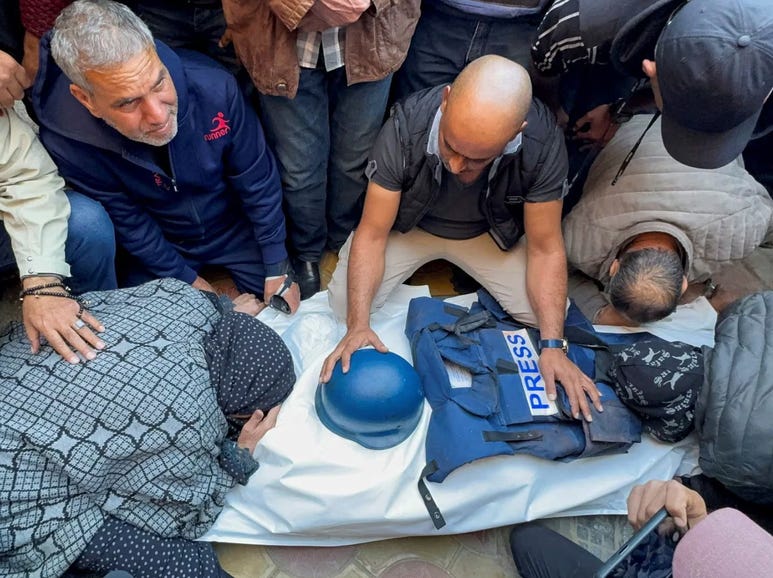
According to New York City-based NGO the Committee to Protect Journalists, as of Dec. 23, 69 journalists and media workers—62 of whom are Palestinian—have been killed in the war since Oct. 7. The Gaza media office estimates a higher death toll of at least 100 media practitioners, while not all of the deaths are confirmed. Some journalists have died from Israel’s indiscriminate airstrikes, but some were more targeted, as in the case of Lebanese Reuters journalist Issam Abdallah, who was fired at from an Israeli tank. Journalists in the region have also faced assault, arrest, threats and censorship at the hands of the Israeli government and the Israel Defense Forces.
“The groundwork of this targeting was laid during the Iraq war, when news organizations that showed American atrocities were branded as accessories to terrorism,” Malekafzali said. “But Israel has taken that to a very literal point and has made Gaza the deadliest place for journalists, if not this year, than certainly in many years.”
There’s no need to wonder what purpose this violent censorship serves. As reported by Politico, the Biden administration was cautious that the temporary six-day cease-fire that began Nov. 24 would allow journalists to enter Gaza and “turn public opinion against Israel” by virtue of the large-scale death and devastation. Public support for Israel is already declining in the United States, and Malekafzali believes this is in part due to the distressing nature of images coming out of Gaza and the fact that it was far easier to suppress similar content in the 2000s than it is today.
“Just recently, there was a video of premature infants that had been left in incubators in a hospital that Israel had told Palestinian doctors to evacuate, and they had just been left there to die,” he said. “These images will continue to come out and their exposure to American news audiences might be limited, but they do get out there and I don’t imagine that the [temporary] cease-fire is going to reverse the trend of public opinion as it is now, where support for a [cessation] of violence is increasing.”
The Palestinian Exception
When Keiles resigned from The New York Times Magazine after signing the WAWOG letter, it wasn’t the first time he had reconsidered his affiliation with the institution. Back in February, he signed an open letter written by a collective of Times staffers and contributors criticizing the publication for its coverage of transgender and gender nonconforming people, which he was reprimanded for. In both instances, he wasn’t sure what was expected of him as a contributing writer—he wasn’t reaping the benefits, labor protections, or union representation he would have if he were a full-time employee, so why should he behave as though he was?
On Dec. 1, Keiles tweeted screenshots of an email sent to all New York Times freelancers with the subject line “Ethics Reminder for Times Freelancers.” The email strongly pushes freelancers to “adhere to the same standards as Times staff members,” with the rationale that readers are likely not differentiating between the work of freelancers and staffers. In the thread, Keiles referred to this circumstance as “a potential [New York Times Guild] misclassification concern” and elaborated over the phone that freelancers being held to the same standards of conduct as full-time employees should have the right to enjoy the same benefits.
“When people picture a journalist, they picture someone with a job. But it’s actually like someone that’s more similar to an Uber driver,” Keiles said. “I think the Times sort of exploits the freelance loophole as a way to avoid offering benefits or labor protections to a lot of people that work for them.”
Keiles also voiced frustration about the vagueness of the New York Timesethics handbook, which is similar to the policies of many other news organizations. He suspects that this ambiguity is intentional, so that Times editors and higher-ups are given free reign to decide how and when these rules should be implemented. For example, in the “Participation in Public Life” section of the handbook, the Times requests that staff members refrain from attending marches or “lending their name to campaigns” with the ambiguous caveat “if doing so might reasonably raise doubts about their ability or the Times’ ability to function as neutral observers in covering the news.”
“The thing that feels the most unfair to me is not the fact of a policy, but the fact that it’s so unclear and that at any point someone can be retaliated against,” he said. “I think even someone that is not being affected by the speech conversation around this war may be affected by these similar working conditions on the next issue. It would be naive to write this off as something that’s self-contained [to] this conflict.”
Keiles is certainly right, but it’s undeniable that Israel–Palestine is especially vulnerable to what Fayyad termed a “culture of fear in newsrooms.” Cohen of Jewish Currents attributed the “except for Palestine” rule to powerful pro-Israel lobby groups that seek to influence politics and media, such as the American Israel Public Affairs Committee (AIPAC).
“There’s a lot of organizations that lobby very hard to push institutions and news organizations to say that any anti-Zionism or criticism of Israel is antisemitism, and they’re very well organized,” she said. “I think that news outlets are extra cautious and extra inclined to punish their staff on [Israel–Palestine] because they’re scared of getting backlash from those organizations.”
The repercussions experienced by journalists who have spoken out during this war—and the hazy, often arbitrary rules that try to prevent them from doing so—will no doubt spark more conversations about free speech and contingent labor rights, but the actual coverage needs a reckoning too.
Disinformation has been rampant since Oct. 7, and many Western journalists and news organizations have failed to challenge these rumors before reporting on them. The account that Hamas had beheaded 40 babies, which even the Israeli army did not confirm, was widely reported on after President Biden falsely suggested that he had seen pictures of the tragedy. More recently, a Washington Postinvestigation found that there is no proof of the Israeli government’s contention that a major Hamas command center was located in the tunnels below al-Shifa Hospital. This claim essentially gave Israel license to launch an assault on the hospital with impunity, which would ordinarily be against international law. Up until now, many news organizations did not dispute or even call into question the IDF’s shaky evidence, even though it could not be verified.
Western news organizations often report without a critical eye on disproven or unsubstantiated assertions made by Israeli officials while casting doubt on Palestinian sources by closely aligning them with Hamas, specifying the “Hamas–run” Gaza Health Ministry or shrouding civilian death toll statistics supplied by Hamas in doubt. It’s fair to cast suspicion on statements made by groups that likely have an agenda, but certainly not in an unbalanced way.
“It would really be befitting of Western journalists to research what Israeli representatives give them to cross check, to follow up and not to immediately give these things credence in the nightly news broadcast,” Malekafzali said. “[For news consumers] I think it’s important to follow both pro-Israel and pro-Palestine news organizations, because you need to be able to detect where narratives match up [and] where they diverge. Exposing yourself to lots of different information sources will allow you to make an independent, reasoned assessment on who is telling the truth.”
Juliana George is the managing editor of Illume Magazine.
 illume magazine
Leave a comment