
The Lao American plant-based creator’s content invites her audience to reflect on food history, cultural erasure, and the way colonialism has shaped not only the diets of marginalized communities but also their broader narratives around food and identity.
By Vienna Chang
DEC 21, 2024
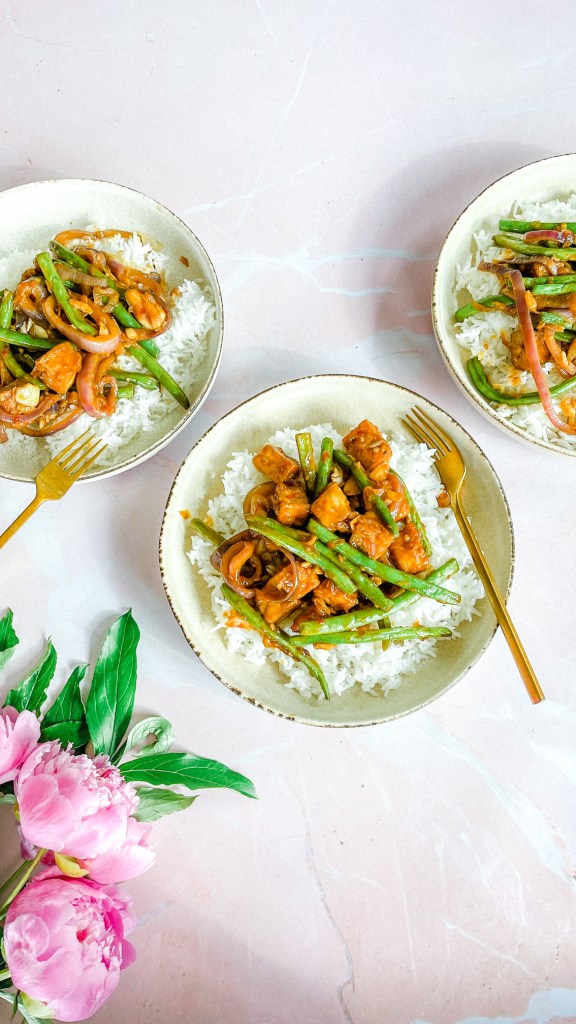
@papayapetite, also known as Sousada, who has chosen to keep her last name private, is a Lao American plant-based content creator on Instagram, where she has amassed a following of over 91K since starting her platform in 2020. She is known for her thought-provoking content that delves into the intersections of food, culture, and identity, with a particular focus on the experiences of the Lao diaspora and her family’s plant-based diet. Extending beyond recipes, her content invites her audience to reflect on food history, cultural erasure, and the way colonialism has shaped not only the diets of marginalized communities but also their broader narratives around food and identity.
Food often holds deep cultural, spiritual, and emotional significance, especially within Asian American communities, where food traditions serve as a vital connection to heritage, family, and history. In a time where Western-centric narratives dominate discussions of health, diet, and veganism, Sousada’s content reminds us that food can be a powerful tool for resistance, reclamation, and justice. By centering food as an act of cultural preservation, art, and activism, Sousada is expanding popular conceptions of veganism and Southeast Asian diets, pushing back against the monolithic ideas of these diets while also uplifting diverse food traditions. Sousada combined her family history and her love of food to interweave the threads of food, love, war, and labor.
In this “Conversational Ruptures” piece, Sousada shares how her deep connection to food is rooted in her identity as a Lao American woman and the daughter of refugee immigrants, describing food as both a creative outlet and a way to preserve her cultural heritage. With @papayapetite, Sousada has created her own pocket of home and comfort within the vegan space online. It’s evolved into a platform for foodies of all kinds—first-generation Americans, papaya salad enjoyers, as well as Lao Americans and other Southeast Asian Americans alike. We dive into the interwoven webs of her history and the Lao diaspora and unpack the creation of @papayapetite and what it stands for today.
Vienna Chang: Tell me about yourself. What’s your name, and where are you from? Where did your love of food begin?
Sousada: My name is Sousada, I’m from Minnesota, and now I live in the Bay Area because of work. I have this dual identity. I would describe it completely as a secret life. I have this whole world in tech that I spent my entire life trying to get into, [and] I see food as this creative outlet. I am a Lao American woman who is a daughter of refugee immigrants. The connection I have to food is so much deeper and beyond passion. It’s a part of my identity. It’s a part of my purpose.
VC: How was @papayapetite brought to fruition and what were your original intentions with it?
S: We would have to go back to college. Growing up Lao American, I was plant-based. Growing up vegan in the ’90s and the 2000s was rough because there weren’t many restaurants that catered to that kind of diet, so the majority of the food that I ate was always at home and it was always home-cooked Lao food. I never knew how much I took for granted my grandma’s cooking until I went to college.
After I finished my first year in college, [that] summer [I] learned everything I could about Lao food from [my] grandma. Almost every day, I would just go to [my] grandma’s house and learn from her. That was the hardest thing ever, to learn how to cook [from an] Asian grandma, because they don’t measure shit. I would stand in the kitchen and she’s got this big ass Asian spoon and she’s like “You put this much in.” The funny thing about [my] grandma [is that] no one in our family could ever learn to cook with her because she was so freaking mean about it. If I cooked with her and I didn’t present it as pretty as she showed me, she would make me redo it over and over and over again until it looked exactly like hers. She’d [say] “If you just wanna eat stuff that looks like trash, you can just eat trash for the rest of your life.” Over the span of four years, I learned almost every single one of [my] grandma’s recipes, and it just became a thing in college where I would throw a vegan Lao cookout.
I knew one day I would want to have a YouTube channel, but I worked in tech. Fast forward to the pandemic. At the time, I was interviewing with tech companies out in Silicon Valley. None of [the] interviews worked out, and I was super depressed. [One day] my boyfriend came home from work and he [told me] “You can’t live like this anymore. you’ve always wanted to start a cooking channel. So why don’t we?” That’s how I started @papayapetite.
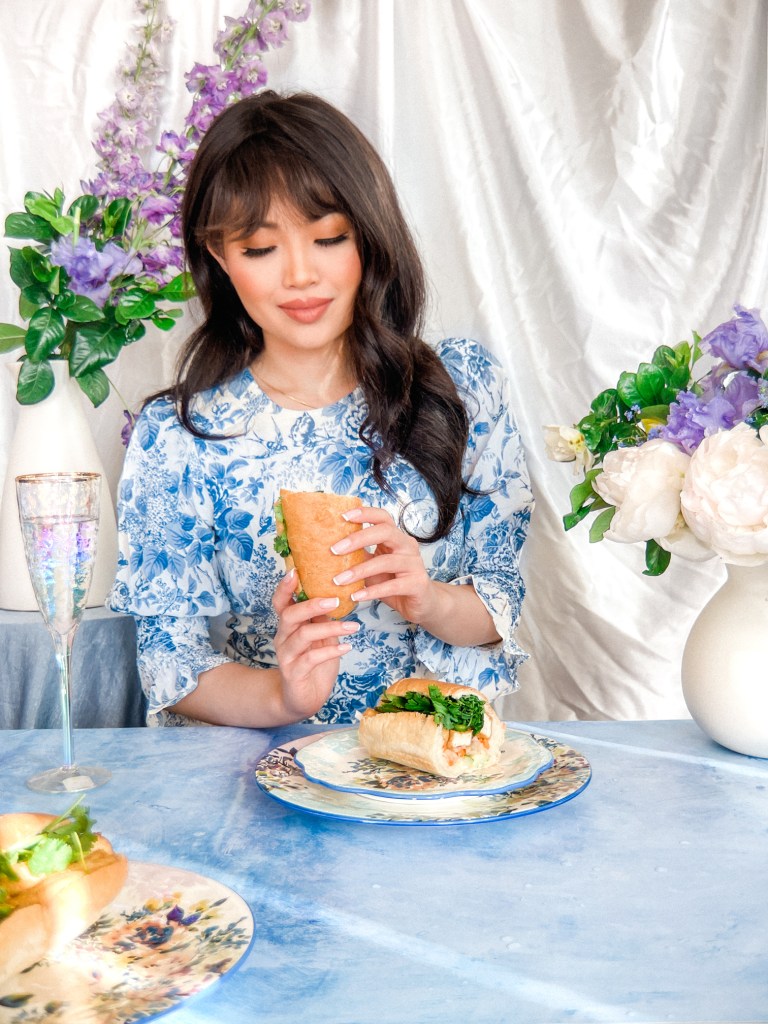
So we make YouTube videos and we find out that it’s super hard. It’s an overly saturated market and it requires a large investment of time. That’s [when] TikTok and Instagram were starting to blow up. [Initially] I didn’t take TikTok very seriously, but there was this one specific video that I made talking about French colonialism within Vietnam and how that led to the creation of banh mi and how banh mi ultimately was the result of Vietnamese resistance and Vietnamese resilience—how they took such a painful experience of being colonized and turned it into this dish that we all enjoy globally. I dove into the history of banh mi. I posted it on TikTok and then almost overnight I had 10,000 followers just from that series alone. That’s when I began to realize that there was this huge appetite for the discourse on food that is meaningful and that is intersectional.
V: Generally we don’t see a lot of Southeast Asian vegan food within the vegan community and the Southeast Asian food community online. There are a lot of preconceived notions surrounding what veganism is, usually rooted in a lot of Western ideas. On the other hand, there are also a lot of monolithic ideas of what makes up Southeast Asian food, policing what’s traditional and what’s not. Now, you built up this platform where you talk about the discourse surrounding the foods and the histories behind it. How have you observed these communities before @papayapetite in terms of food? And how do you think @papayapetite disrupts and shapes these narratives now?
S: The very notion of Lao food itself was super monolithic, especially within the Lao diaspora, because the Lao diaspora [is] a result of a war that happened in Southeast Asia [that many] people don’t know about. A lot of things are talked [about in] the context of the Vietnam War, but there was a separate war that was going on in Laos called the Secret War. The reason why I’m talking about the Lao diaspora is because, for a lot of Lao people and for a lot of Southeast Asians, in [times of] struggle… there’s comfort in food. That’s a common thing [among] immigrant families, that despite the hardships, they always find ways to make their traditional foods.
It’s important because in America you have a generation of Lao Americans [struggling] with American assimilation… trying to cling to the traditions of their Lao American identity. [This] led [many] to believe that there could only be one way to be Lao. So because of that, Lao people, especially Lao Americans, grew to become very protective of their food. Even before I started @papayapetite, [I saw] these vegan bloggers who would make attempts to make Lao food and completely ruin it. So [with] @papayapetite, there was already this pre-existing attitude [that] when anybody tries to vegan[ize] Lao food, they just bastardize it. So when I started @papayapetite, there was so much backlash, not just from the Lao and Southeast Asian community, but also backlash from vegans.
The other problem is that veganism was still practiced through a very white Western lens, and so concepts I was exploring on my channel—like food justice and food accessibility—would piss off the white vegans. Then on the other hand, you have these Lao people who are [saying] “You’re fucking up our food.” It was really important for me to be grounded in having conviction in what it is that I would do in creating this platform, really knowing where I stood in the world, knowing where @papayapetite would stand in the world and what it stands for. I know that what I stand for is that you can celebrate and make vegan Lao food without compromising integrity and taste because what makes Lao food Lao food isn’t the meat itself.
V: Do you think there are dishes out there that tell a story simply within its creation and assembly?
S: I feel like so many foods speak for themselves, and especially Southeast Asian food speaks for [itself] inherently because, if you try any Southeast Asian dish, it typically [is going to] hit at least four different flavor profiles: you get spicy, sour, sweet, and savory all in one bite. I feel like our flavors just make you feel alive. It brings this liveliness, this life force that exists in Southeast Asian food. If you were asleep and you took a bite of papaya salad, [it’ll] wake you up and make you cry at the same time. That’s our food. I think our food has so much life in it because it hits all these different flavor profiles and I feel like the world is so unaware of that. Food speaks for itself. You have a bite and even if you don’t know the history or the background, you can taste it.
V: We don’t really see Lao food on the map, let alone Lao vegan food. Where do you hope to see that space evolve within the next few years?
S: This is really interesting because I remember my friend [saying that] Lao food is about to be put on the map. For me, I had already done some internal exploration by asking myself at the very beginning [of] @papayapetite: what if nobody ever accepts your food? Would you still continue to do what you do? Why do you want to create @papayapetite? Why do you feel a drive to want to educate the world about vegan Lao food? Does it come from a place of ego? Does it come from a place of justice? Does it come from a place of compassion? Who are you doing this for? Is it for yourself?
I’m so glad I challenged myself to answer those questions. As far as vegan Lao food, like putting things “on the map,” when you deconstruct the concept of “on the map,” what does that mean? That means mainstream acceptance. Like Korean food, it’s been on the map for the last few years. You go to a random Trader Joe’s and they’re going to have kimbap—that’s a marker of mainstream success. That, to me, is what it looks like when any sort of ethnic cuisine is “on the map.” The question I have to ask when people want things on the map is: why is it important to you? What if it never is, is it gonna make you frustrated? Why do you want people to actually know about Lao food? It’s an existential question.
Ultimately, [I] realized [that] when I [make] a video on @papayapetite, when I make the food, first and foremost, it is for my people. My target market is Lao people. For those reasons, Lao food being put “on the map” or not, isn’t something I’m concerned about. Now, if Lao food was put on the map, would that make things easier functionally? Oh yeah. I think it might be a dream if I could go to a Trader Joe’s one day and there’s vegan fish sauce there. Or if I want to make papaya salad, I wouldn’t have to go to an exclusive Southeast Asian [grocery store]. [But] I don’t feel obsessive over Lao food being put on the map like [I used to]. I don’t need any external validation.
V: I get it. It’s, in a way, a form of self-preservation trying to keep the community together and not having to water down the way we do things just to make it palatable to a white audience. Now, we’ve talked a lot about your background and how it has led to the creation of @papayapetite, your creative process, and the reactions towards @papayapetite. I want to pivot. What is your favorite dish? One that feels like home and community?
S: That’s such a hard question to answer because there are just so many. If I absolutely [had to] choose one dish, nam khao poon is just… I have a really special connection to nam khao poon because my grandma, she’s the one who taught me how to make it from scratch. Your typical family, when they’re making nam khao poon, they’re going to purchase the curry paste and the coconut milk at the store. I don’t do that. I was taught by my grandma that when you make nam khao poon, you’re going to spend 3.5 hours making your own curry paste and you’re going to spend also a separate amount of time making the coconut milk from scratch on your own. That’s why for me it’s that dish that brings me to that memory of the labor of love.
Vienna Chang is a media and screen studies and communication studies major at Northeastern University.
 illume magazine
Leave a comment