
What can Supreme Court cases from the early twentieth century teach us about the racial logics present in contemporary affirmative action jurisprudence?
By Jesica Bak
DEC 21, 2024
The following is an introductory excerpt of the author’s senior thesis.
On June 29th, 2023, the US Supreme Court overturned decades of affirmative action precedent in Students for Fair Admissions, Inc. v. President and Fellows of Harvard College (henceforth ‘SFFA’), one of the most historically unprecedented cases regarding race-conscious admissions in higher education that had been in progress—and as such, constantly evolving, circulating, and presenting new logics—for nearly a decade. The story, however, does not begin with Edward Blum—who Claire Jean Kim rightly refers to as “a [w]hite conservative who channels funds from right-wing donors into high-profile legal campaigns aimed at rolling back the race-conscious reforms of the civil rights era”—intentionally recruiting Asian American plaintiffs for the SFFA case because he had just lost Fisher v. University of Texas and realized he needed a new strategy.
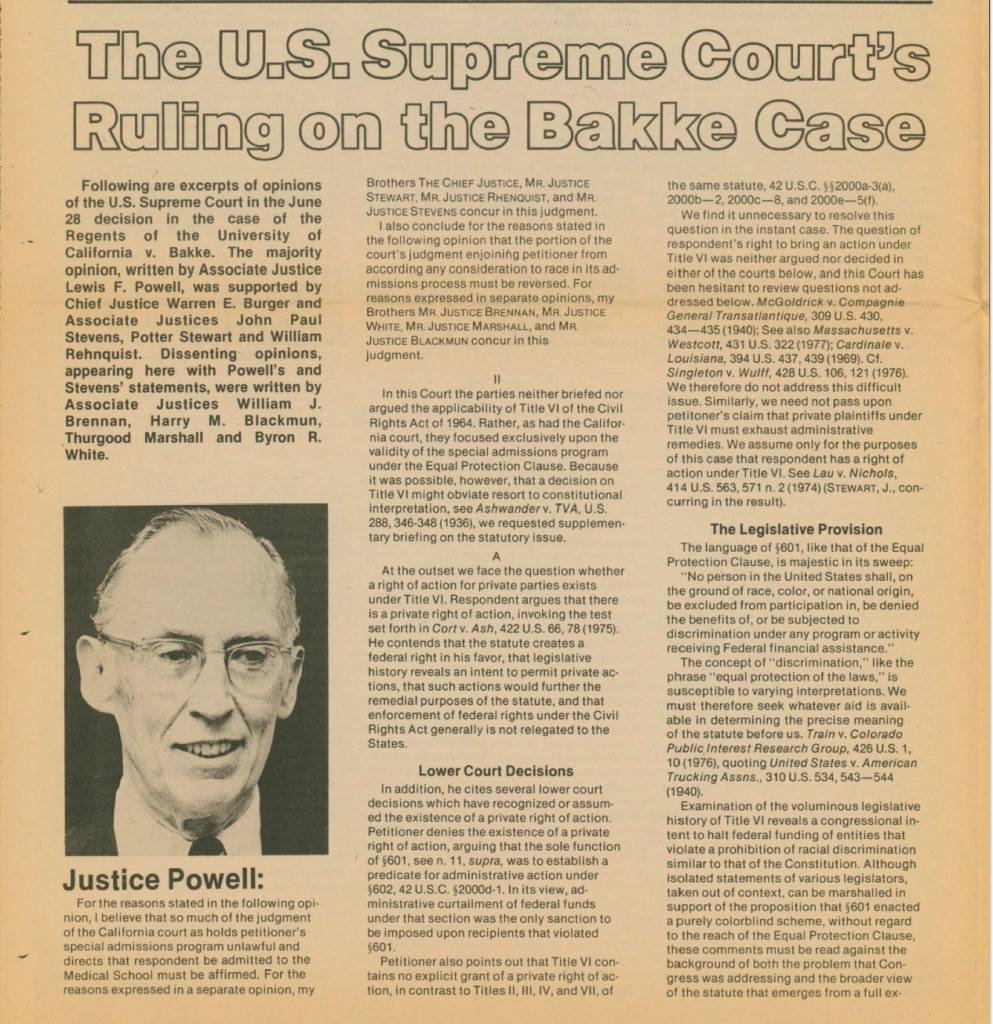
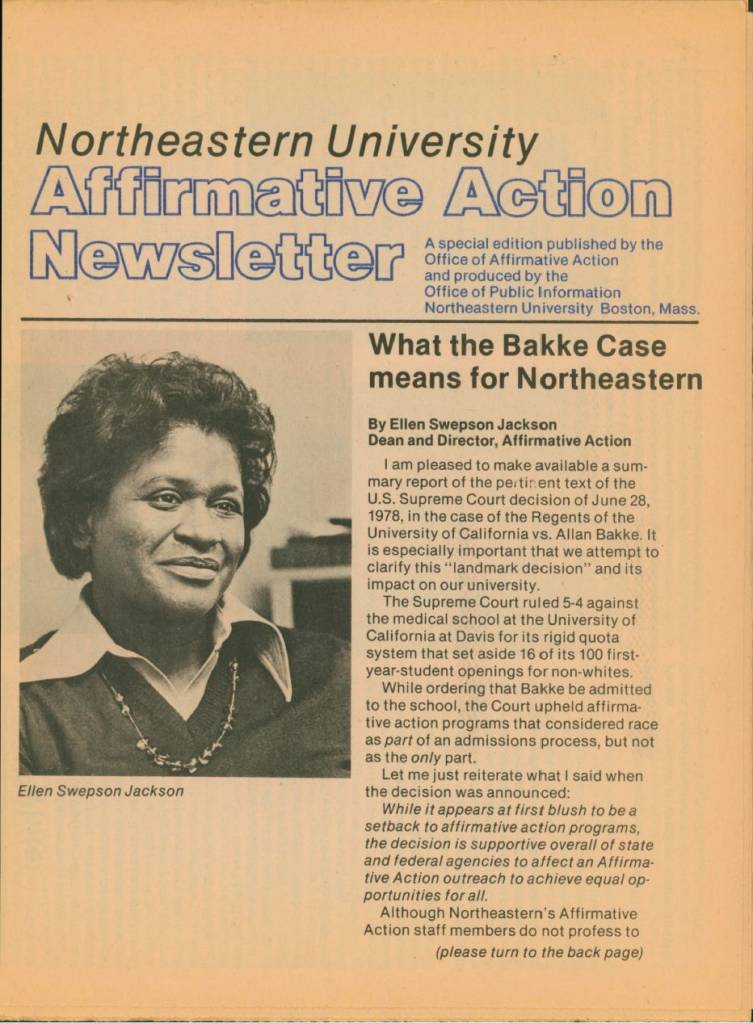
The story doesn’t even start with Blum first attempting to eliminate affirmative action by backing his white plaintiff in Fisher in 2012, nor with his backing of the Shelby County v. Holder case a year later that effectively overturned a key provision of the landmark Voting Rights Act of 1965, one that was meant to protect historically marginalized voters in jurisdictions with histories of racial voting discrimination. Is the starting point, perhaps then, the landmark Regents of the University of California v. Bakke case in 1978 that effectively set the narrow precedent for affirmative action on the basis of compelling diversity interests that we would see maintained for the next forty years? I ask these questions not to posit a “right answer” for locating a specific origin point as to when affirmative action and race-conscious policies became a divisive and contested issue in the US landscape, but to instead draw our attention to the long, messy history of mediating Asian Americans in the ideological project of race construction and reification.
Because as the story turns out, Blum was extremely successful in gathering a coalescence of Asian American students, and their parents, who felt that there was an unfair racial quota system in place inhibiting them from gaining acceptance to Harvard despite their high “stats”—thus the nonprofit Students for Fair Admissions, or SFFA, was born. The case of one poster child for Blum’s campaign in 2013, Michael Wang, is particularly insightful: “with near-perfect test scores, stellar grades and a pages-long resumé of extracurricular activities,” he wanted to know why the colleges he had applied to had rejected him, and how much race had to do with their hidden admissions process. Despite claiming to not be “anti-affirmative action” (he apparently just wants it “reformed”), Wang’s story was repeatedly shared in the never-ending slew of media coverage on the SFFA case, along with his then-explicit belief that colleges were wrongly using affirmative action to “help some historically marginalized students but disadvantage others.” The implicit subtext that emerges here—essentially that race-conscious policies benefit Black and Latinx students at the expense of Asian Americans—is not unique to Wang’s viewpoint, nor does this new framework emerge in isolation.
We see it emerge countless times throughout the decades-long mainstream media coverage of the case, but also fascinatingly imbued in the site of the digital content creation realm. Months before the SFFA ruling but still in the thick of the case, Jay Caspian Kang, a Korean American writer who is by now well known as the intellectual media representative of all Asian Americans and Asian American topics, wrote a short piece for the New Yorker on a new and particular content creation market of students, “stats,” and the anxiety of college admissions. Detailing the thousands of videos on TikTok of young students attempting to make sense of their inability to gain acceptance to institutions like MIT or UCLA despite their entire lives spent working towards nothing else—and with the stats to prove it—Kang’s piece is particularly analytically harrowing when he focuses on one Asian American content creator, a sophomore at Duke University, whose TikTok account is dedicated to predicting where his followers will gain admission to based on the stats they’ve sent in to him. Kang writes:
It should come as no surprise that Lim and many of the people who post these despairing videos are Asian American. The anxiety that underlies these videos and the popularity of Lim’s version of real talk—he has more than a hundred thousand followers on TikTok—come from the growing consensus among Asian American families and their teen-age children that these colleges do not want them on their campuses, regardless of their accomplishments.
Earlier this year, Lim posted a video about the racial makeup of admitted students at Harvard and Yale. He did the math that’s become almost gospel in a lot of Asian households and noted that fifty-six percent of African American applicants in the top decile get into Harvard, compared with just thirteen percent for Asian Americans. When one looks at the chart, Lim explains, what becomes clear is that you can be a Black student in the bottom forty percent of applicants and have the same chance as an Asian American student in the top ten per cent.
Not dissimilar to the young students who make these videos in the first place, the underlying subtext of Kang’s piece—while right to address the despair that youth are feeling in the neoliberal education system and labor market—is that the despair, once again, comes from an unfair system that privileges Black students at the expense of Asian American students, meritocracy be damned. In the immediate wake of the official ruling overturning decades of affirmative action precedent and ten years after he was first recruited for SFFA, Wang admitted that part of him regretted his role in the anti-affirmative action movement and that he “did not understand the magnitude of the situation… until the Supreme Court shifted to a conservative majority.” To this day, it is clear that Wang, who is now in his late twenties, still does not hold a firm position on affirmative action. Nonetheless, his critical role in the mobilization and coverage of the case illustrates the broader convergence of conservative Chinese—and Asian writ large—immigrant advocacy groups (like the Asian American Legal Foundation and 80/20) with a more traditional coalescence of white nationalism, to ultimately stand in for all Asian Americans.
This new racial framework hasn’t emerged in isolation precisely because throughout the decades-long legal process, a critical aspect of SFFA’s strategy in their broader goal of dismantling race-conscious policies and ideology writ large was its repurposing and recalculation of the beneficiary/victim. If the framing was once that affirmative action policies benefited Black and Latinx students at the expense of whites, SFFA’s injury claim and legal framework strategically shifted the framing to such policies benefiting Black and Latinx students at the expense of Asian Americans—making it harder to legally justify an already-precarious rationale. Understanding this strategic shift is crucial to understanding the long-term implications that the overturning will have, and indeed already has started to have, on cross-racial solidarity and relations between Asian and Pacific Islander Americans and Black and Latinx Americans.
To be sure, the theorization of how Asian Americans have always occupied a mediary position in the Black-white binary of the US racial hierarchy is not a new one, and scholars like Dana Takagi (1992) and Mari Matsuda (1996) have written powerfully on how affirmative action jurisprudence is an imbued site for positioning the group as the “racial bourgeoisie.” And while it is not the point of this piece to re-argue and re-articulate that this notion of Asian Americans being injured by affirmative action at the alleged “benefit” of Black and Latinx students, must be reevaluated as a fallacy and more importantly, as a strategic attempt by the white hegemon to preserve whiteness at institutions that can otherwise provide powerful elevating opportunities for people of color, I start from this point of analysis to ask how the SFFA case has marked a new temporal demarcation in our collective understanding of what it means to have race-conscious admissions in a US order predicated on anti-Blackness and mediated through Asian Americans.
Indeed, Claire Jean Kim has already done the work of tracing for us how Asian Americans have been mediated in this racial framework since Bakke. She stunningly traces the language in Justice Powell’s opinion for Bakke, who configures Asian Americans (or “Orientals,” written by Powell’s clerk) as “spoilers”—an ethnic group that has also been subject to racial discrimination, thus complicating the question of which historically marginalized group “deserves remedial consideration” in the question of affirmative action. In other words, “if Asian Americans are a ‘minority’ and thus discriminated against… how are they able to gain admission in ‘large numbers’?” (Kim 2018, 6). Is the answer here purely based on merit? Before one answers this question, they must first note how Powell invokes a sociometry that denies the structural order of group positionality as predicated on anti-Blackness, instead believing in an entirely unitary concept of discrimination that obscures the differentiated positionings of non-white groups in the social order.
This means that to Powell and his clerk, all minorities are literally the same, and hold the same amount of power, and face the same challenges—allowing for an apolitical and ahistorical analysis that invokes Asian Americans to not only de-specify anti-Blackness in the US, but to effectively delink affirmative action from its original remedial rationale for one that instead focuses on the arbitrary purpose of “diversity.” Then, the question from before—on whether Asian Americans have actually been able to gain admission despite facing discrimination due to true meritocracy—becomes obsolete, because as Kim states for us: “[T]he question of how Asian Americans are succeeding despite discrimination—’How do they start out in the same place as Blacks and end up farther ahead?’—is not on point. A better question is ‘How are Asian Americans positioned differently from Blacks in the social order such that the specific advantages, immunities, and burdens that emerge from this position shape their group outcomes relative to Blacks?’” (Kim 2018, 10). If one is actually able to untangle the legal (il)logics that frame affirmative action jurisprudence, it is possible to see how conservative members of the federal judiciary use the law to shape the opportunity outcomes for certain ethnic groups over others, but above all keep outcomes in the hands of the white elites.
As scholars at the intersection of law and critical race studies have extensively written out for us, race is not only made real through the law, but racial categories and meanings profoundly shape the distribution of goods in society. Beneath the “contemporary edifice of prima facie racially neutral laws and policies” via colorblindness, Kim illuminates for us, is a system that continues to obscure patterns of white racial domination first and foremost through the racial triangulation of Asian Americans vis-à-vis Black and white Americans. Taking us through the arrival of Asian migrants to the US in the mid-nineteenth century to the cosmetic changes of the post-1965 civil rights era, Kim shows us how white elites have always positioned the racial category of Asian (immigrants) as superior to Black (enslaved) for the narrow and temporary fulfillment of labor exploitation, but forever foreign and unassimilable to whites. The fact that Asian Americans have always been situated at a particular conjecture between white supremacy and Blackness is thus a priori to the way the group has been configured in affirmative action jurisprudence by conservative legal groups and a new contemporary formation of white (and Asian) elites—the latter cannot exist without the former. While the deconstruction of colorblind ideology and its dangers is permeated throughout interdisciplinary scholarship examining the intersection of race, law, and narratives in the US context, I note here that like Cheryl Harris, who argues that colorblind ideology is the contemporary enshrinement of the property interest in whiteness, Kimberlé Crenshaw also addresses the project of colorblindness as not a mere matter of policy, but as “installing a particular orientation towards inequality itself” (Crenshaw 2007, 126).
While the SFFA decision was a new landmark victory for the conservative project, Blum has actually filed over two dozen cases since the 1990s with the mission of removing the very concept of race from the US legal system. Here, we must be reminded that “legal rhetoric functions as a regime of truth and power.” And if there is anything we must learn from the deep, historic connection between Justice Antonin Scalia’s version of textualism—the dominant method of statutory interpretation amongst the federal judiciary—and his father Salvatore Scalia’s leading approach to New Criticism, it is that form invariably elides into politics. As an “empirical, formalist approach to literary criticism,” the New Critics argued for a kind of criticism that would purportedly be objective, scientific, precise, and systematic, and it is precisely this methodological approach to that would go on to inform law and legal interpretation as predicated on a bounded notion of scientific objectivity. In other words, Blum’s project to “remove the concept of race” from the legal system, and to move towards the ideology of colorblindness instead, cannot be treated simply as an act of removing textual language from legal interpretations or legal frameworks; it must be treated as an ideological project of shaping our collective conception of power (who has it and who doesn’t), in order to materially keep power in the hands of those who get to determine what the law is and how to apply it selectively.
I continue to look to the site of the law and the legal realm to respond to the question: What has the racial logics embedded within the Students for Fair Admissions, Inc. v. President and Fellows of Harvard College case, and its official ruling last year overturning decades of race-conscious precedent, done to the ongoing figuration of Asian Americans in the legal-ideological project of colorblindness? How are racial subjectivities changing in accordance, or perhaps in opposition, with this ongoing, contemporary legal-ideological project of eliminating race-conscious policies and theories writ large? Due to the fact that the ruling took place only last year, scholarship on the case and its profound effects on US racialization remains limited to the actual duration of the case but before the 2023 ruling overturning decades of affirmative action precedent. Moreover, as I have articulated, scholarship has already looked to affirmative action case law and jurisprudence for theorizing Asian American mediation. My analysis remains within the legal realm because I believe the law is a critical and imbued site for thinking about how configurations of race are naturalized and legitimized through the law, but also for thinking about how race remains intertwined to a bounded notion of scientific, empirical objectivity through the law. If race is made real through the law, the law is what continues to reify it.
I employ a historicization and legal analysis of US Supreme Court cases from the 1920s that are indeed not about affirmative action policies (which were enacted and formalized in the 60s and beyond) but have already taken up the injury claims and themes that would later be imbued in affirmative action jurisprudence: ideas contesting race and the material benefits that are only accrued to certain categories of race, namely whiteness. As we shall see in the following three cases—Ozawa v. United States (1922); United States v. Bhagat Singh Thind (1923); and Gong Lum v. Rice (1927)—there are real material, vested interests only afforded to and protected by whiteness, explaining why these Asian American plaintiffs worked to legally contest the nation-state’s ill-defined, unstable definitions of whiteness. As these plaintiffs claimed to be white and the US in return argued against such claims, we are able to witness the procedural and dialectic relationship between Asian Americans and the state, and how both parties situated Asian Americans in relation to whiteness, but also Blackness. I believe that this legal-historic analysis—tracing the material relationship between race and the law to situate how Asian Americans have always been depoliticized and configured at a particular conjecture between white supremacy and anti-Blackness—provides an analytic pathway to understanding the contemporary moment in which the SFFA ruling has once again, placed Asian Americans at the same conjecture. Indeed, now this configuration and depoliticization is more tailored to the legal-ideological project of colorblindness, subsumed in and through the discourse of meritocracy and assimilation.
Jesica Bak is the editor-in-chief of Illume Magazine.
 illume magazine
Leave a comment