
Illume speaks with Mariam Hassan, Egyptian American activist on the Palestinian liberation and solidarity movement.
By Juliana George
FEB 19, 2024

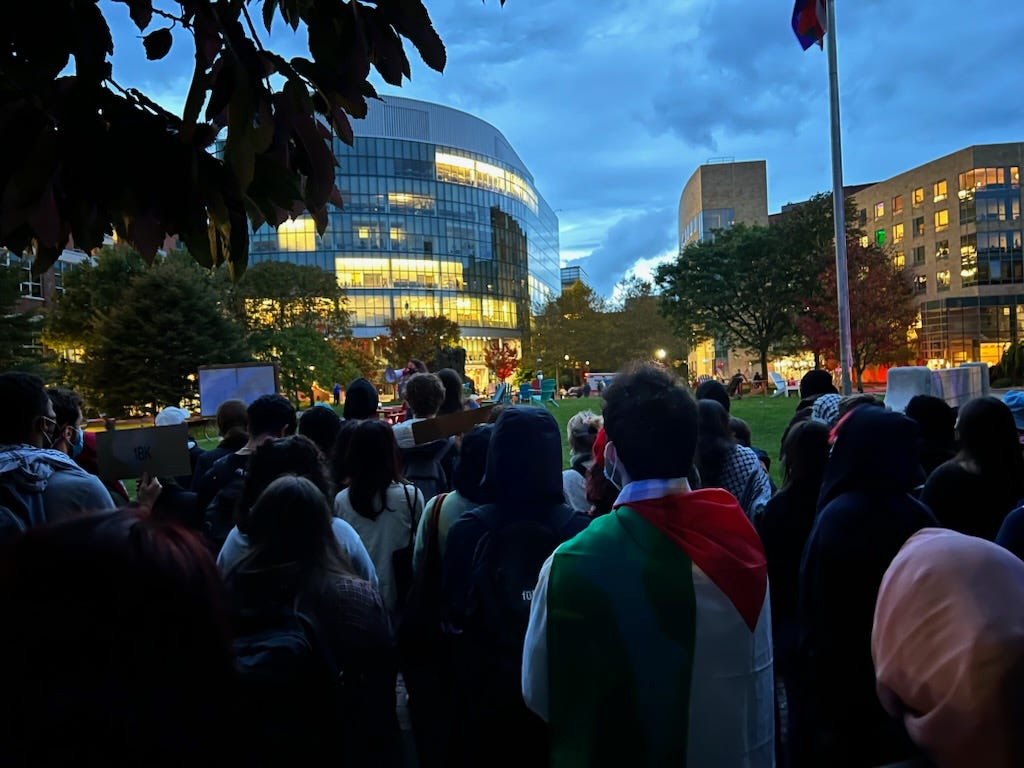
The afternoon of Nov. 9 was cold and rainy, but that didn’t stop approximately 70 demonstrators from gathering on Centennial Common to protest the ongoing genocide and intensified siege on the Gaza Strip waged by the settler-colonial, apartheid state of Israel—as well as Northeastern University’s failure to acknowledge this U.S.-backed bombing campaign that has, as of Nov. 23, killed over 14,000 Gazans, a likely underestimated figure. Protestors set down scraps of cardboard and plastic ponchos on the damp walkway and sat or lay in silence as speakers read poetry from Palestinian authors and occasionally called upon passersby to participate in the demonstration.
The die-in was organized by Huskies for a Free Palestine, or HFP, a student group that is unaffiliated with Northeastern. Subsequent pro-Palestine protests on campus have included a chalk-in Nov. 15—organized by the Northeastern University School of Law Students for Justice in Palestine and the undergraduate Students for Justice in Palestine, or NUSL SJP and NU SJP respectively—and a rally on Cabot Quad Nov. 16 organized by the same groups. During the chalk-in, students spent over six hours writing the names of 2,500 of the over 14,000 martyred Palestinian civilians who have been killed since Oct. 7 in a sprawling display that snaked around the entirety of Centennial Common.
As students of Asian-American studies, we hold personal and political stakes in demystifying the interrelated global histories of colonization and decolonization; diasporic sites and communities; empire, state, and nationhood. As for our individual positionalities, we recognize that as of now, Illume’s team is broadly made up of Asian Americans who have grown up in the U.S. and, largely, are of East-Asian descent. Watching from our campus and homes in Boston, we are physically untouched by the violence in Gaza as well as unmarked of the real potential for harm that exists for Palestinians, other Arabs, or even those arbitrarily and racially marked as such, in America.
Dylan Saba, a Palestinian civil rights attorney for Palestine Legal and writer, states this material gap best by writing of his conversation partner Darryl Li, a fellow activist and professor of anthropology and law at the University of Chicago: “The perception of middle-class East Asian Americans as depoliticized, especially when it comes to Palestine, has enabled him [Li] to engage white people and Zionist Israelis without triggering the same racial reflex as someone they read as Arab or Muslim.” As such, we do not pretend that our thoughts and writings are complete nor constitutive—and yet, we feel, as penned by Audre Lorde, that our silence will not save us.
Illume recently had the chance to speak with Mariam Hassan, a first-year student at the Northeastern University School of Law. Hassan is an Egyptian American activist for the Palestinian liberation and solidarity movement whom we came into contact with when she spoke during a rally for Palestine back in October. While not necessarily representative of each and every member of the student activists in the transnational Palestinian solidarity movement, Hassan speaks with us about the goals of campus groups in and beyond Northeastern advocating for Palestine, including an immediate ceasefire; the suppression they are currently facing by universities across the U.S.; solidarity with other racial-ethnic justice groups; and the challenge of responding to claims that all speech and organization in support of Palestine is antisemitic.
—Jesica Bak and Juliana George

This transcript has been edited for length and clarity.
Juliana George: First of all, could you tell me a little bit about your background and what organizing for Palestine means to you?
Mariam Hassan: I’m an Egyptian American, and for a lot of people growing up in the Arab diaspora, we’ve just always [known] that Palestine has been occupied. Many of us have lost family members, or even land, so it’s not really a Palestine–Israel issue as much as it is an Arab–Israel conflict. But obviously, after Oct. 7—and [other events in history such as the 2021 attacks on Sheikh Jarrah]—you see the Muslim community and the Arab community as a whole unite in terms of advocating for Palestine and making sure that the world knows what’s happening in Palestine.
JG: Campus groups, such as students from the law school and the undergrad coalition for SJP [Students for Justice in Palestine], and HFP [Huskies for a Free Palestine] have held a number of protests on campus since Oct. 7, recently including a die-in and a chalk-in. How do you feel that these protests went and where do you draw similar organizing strategies from?
MH: So the point of organizing on campuses—but also in general, in Boston as a whole and even the United States as a whole—it’s all part of a big tree and then there’s little branches. You can do something large scale, such as the D.C. protests, you can do something slightly smaller but still large–scale, such as all the different Boston protests, like in Copley, but our universities are also a subgroup of that larger tree.
Each of our events have different goals. For example, the goal of [the chalk-in] is to display the names of the people and show how egregious it is that we are 39 days into a war, or a “war,” and that we are 12,000 names into a list, and we’re still not calling for a ceasefire; our universities are partially responsible for that. So, it really is supposed to be an emotionally compelling strategy of getting people involved. When you have something like the die-in, or something like a rally or a walkout, that’s more supposed to be disruptive in terms of showing the university that we are frustrated. We know that the university is complicit, and [we are] directly calling on the university to divest, whether that’s from different co-ops or different study abroad programs, and calling [on] our university to make a statement against genocide as well.
JG: HFP’s demands towards the university have been very specific and clear, including a reissued statement in support of the Palestinian people; assurance of safety of the Muslim, Arab and Palestinian students on campus; prevention of online harassment of students in support of Palestine; termination of relationships with companies complicit in Palestinian genocide; and divestment from the war industry. You can answer for NUSL SJP — can you talk about the wider goals of the Palestinian liberation movement?
MH: We saw the statement from [President Aoun] and from different professors in general calling out the violence against Israeli civilians, and we haven’t seen that same energy when it comes to the Palestinian civilians, when the reality is it’s a much greater number of civilians that have been killed; Palestinian civilians are at 11,000 [now over 14,000] and the Israeli civilians are at 1,200. It’s just not a comparable reaction from the university. So, [the goal] is calling on them to be a little bit more consistent in terms of calling out the violence, but also in terms of protecting free speech. For universities to take down pro-Palestinian posters within less than 24 hours, it’s just very frustrating. It shows where the university stands in terms of genocide and free speech, and it’s very clear that free speech does not extend to speech that advocates for Palestinian rights and Palestinian liberation.
JG: I know SJP — the undergraduate SJP — has had several run-ins with the Northeastern administration over the years, ultimately leading to probation in 2013 and suspension in 2014. And last week, Columbia University suspended their own chapters of SJP and JVP [Jewish Voice for Peace.] Just last month, HFP’s die-in was rescheduled due to threats from Northeastern CSI [Center for Student Involvement]. At Harvard and other universities around the country, students who protested or even expressed their support for Palestine have been arrested, doxxed and harassed. What other silencing tactics have pro-Palestine student groups faced from the Northeastern admin?
MH: There is this constant fear factor that students have to live through when they’re advocating for Palestinian rights. That goes throughout all of the different schools, but at Northeastern, a student was assaulted by the Northeastern University Police Department [NUPD], and other students have been verbally assaulted by NUPD—here we are almost a month after these incidents, and nothing has been investigated.
Another example is that so many Northeastern professors have made statements of support for Israel. I mean, you have a Ph.D. student referencing Muslims as Nazis, and all the different departments that we’ve asked to investigate this have not investigated it or have said that it’s covered under free speech. But the second that a student says “from the river to the sea,” that’s antisemitic, or the second that a student makes a statement or helps organize something for Palestinians, all of a sudden you hear the deans and different people of authority condemning students or calling them out or [saying] “Donors are scared now.” Northeastern entices students to attend the school with claims that we’re so pro-discussion and diversity and all of that, but it’s become very evident that the university’s invitation to diversity is not directed to pro-Palestinian students or even to their safety… It’s really [on] so many systematic levels that the university basically tells us that they don’t care about us, they don’t care about our safety, our rights to free speech, our rights to protest.
JG: The ADL, or the Anti-Defamation League, recently sent a letter to President Aoun and hundreds of other university presidents calling for an investigation of SJP chapters and any other pro-Palestinian campus groups with the accusation that such groups are celebrating terrorism and discrimination against Jewish students. Both HFP and SJP have stated explicitly that they are against antisemitism. How do you respond to and challenge the conflation of all organizing for Palestinian liberation as antisemitic?
MH: I think any discussion of whether or not pro-Palestinian liberation is tied to antisemitism is [a way] that Zionists distract from the Palestinian movement as a whole… The biggest way that I can prove that pro-Palestinian liberation is not antisemitic is if [it] were, then [JVP] wouldn’t have been getting involved. The JVP has been so vocal about their support for Palestinians, [invoking] “not in my name” and all these different slogans. Zionists, not Jewish people, but Zionists use antisemitism as a form of instilling fear in pro-Palestinian advocates and pro-Palestinian groups, and they completely change the narrative. That’s their way of doing it: they put you on the defensive instead of you being on the offensive, where all of a sudden you’re having to defend yourself and claiming that you’re not antisemitic, even though you’ve done nothing even remotely close to being antisemitic.
So my question to the [ADL] is: why are you Islamophobic? And why is it that your organization is so scared of Muslims and so scared of Palestinians—because they do relate the two together, even though we’ve discussed that the Palestinian liberation movement is not a Muslim movement. I mean, there’s Jewish Palestinians, there’s Christian Palestinians, and it really has nothing to do with Muslims versus Jews. So when you see all these different institutions trying to instill fear in Palestinian students and Palestinian advocates by conflating the two, I will just uno reverse on them and ask them why is it that you’re so scared of Muslims? Why is it that it’s okay for a Northeastern professor to call them Islamist Nazis? I mean, that seems to me to be more Islamophobic than anything.
JG: Right. In the sixties, the free speech movement on UC Berkeley’s campus drew from disobedience tactics used during the civil rights movement and in turn, influenced future protest movements. How do you think campus organizing relates to the wider political struggle for Palestinian liberation in the US?
MH: I think [when] fighting for any group’s justice or equality, all of these systems of inequality are related to each other. One very direct relationship between Palestinian liberation and other social justice groups is with Black Lives Matter. After George Floyd was killed, brutally killed by police officers that were trained by the IDF, [protesters] were tear gassed. When they were scared about tear gas and they were being sprayed by police officers in their different protests, the Palestinians are the ones that told them that milk is going to help decrease the effects of tear gas. [Hassan later added over text that the “knee-on-neck strategy that killed George Floyd was invented by the IDF”].
So when you see all these different Black people advocating for pro-Palestinian rights, to an extent—and not just Black people, but people in general advocating for pro-Palestinian rights—we’re advocating for Black rights [and] we’re advocating for an end to police brutality because those two systems are very related. There’s lots of different graphics online that talk about cop city and the IDF and how those two are related to each other and how systems of oppression are linked to each other. Fighting or trying to dismantle one system of oppression is in itself a form of trying to dismantle the other system of oppression.
JG: How would you recommend students who are new to organizing get involved?
MH: I think the best way to do it is to stay up to date with different social media accounts. There’s a Northeastern University SJP, that’s @nusjp, and then @nuslsjp and Huskies for [a Free] Palestine [@hfpneu]. [Those accounts] share other information about events happening in Boston, and a lot of times they collaborate on those events. And so get involved on campus, but also get involved in Boston in general. And in doing so, you’ll get involved in the larger movement as a whole.
Juliana George is the managing editor of Illume Magazine.
 illume magazine
Leave a comment